Category: Blog

Tenet Blog

  • The role of environmentalism in modern consumer brands

    Patagonia is a brand that is so eco-friendly their CEO would rather teach you how to repair your fleece than sell you a new one. As a certified B Corp, their brand promise is built on environmental activism, placing business philanthropy at least on par with profits. At The North Face, on the other hand, they believe “the best way to be sustainable is to make product[s] that would last a lifetime.” As a result, their brand promise is focused on innovation and durability.

    We view a brand promise as the core idea that unifies your brand. It is a distillation of your brand positioning, which is in turn built on a foundation of positioning attributes. These attributes range from foundational – meaning you must have them simply to be in your industry – to differentiating – meaning they are distinctive and set you apart from your competition. These elements, collectively your “brand platform”, are internal but drive the outward expression of your brand – including in marketing communications.

    This means that while we may not be able to see the brand platforms for Patagonia and The North Face, we can infer certain priorities based on their external communications including websites, advertising and press interviews, among other things. For both brands, environmentalism / sustainability is present in their communications, but it plays a very different role for each.

    For The North Face, environmentalism seems to be a foundational attribute. Sustainability is important to the brand – for example, “Protect” is one of their three core tenets of corporate responsibility, alongside “Product” and “Empower.” However, with so many other outdoor and sportswear companies focusing on their environmental credentials, The North Face feels they need something more. For them, that “something more” is making the product the hero – but sustainability still gets its play, with the idea of creating less waste implicit in their claims about durability.

    For Patagonia, on the other hand, their environmental mission is their prime differentiating attribute. In the words of the founder’s nephew, “There was a strong sense from the beginning of wanting to protect the wild places.” Their “Provisions” line of sustainable food, a focus on protecting their supply chain and “Patagonia Action Works” – a network to connect individuals with grassroots environmental activists – are just some of the ways they demonstrate their dedication to corporate stewardship.

    Patagonia is not alone in this trend. It is becoming increasingly common to hear brands talking about their “purpose,” beyond delivering shareholder value – at Cannes Lion 2019 the topic was discussed extensively by top brands including Unilever and P&G. The key here is not to view it as an either/or proposition –brands are seeing that authentically committing to a higher purpose can actually increase revenue from socially-minded consumers who want to reward like-minded corporations. But that word, “authentically” is pivotal – if brands are talking the talk but not walking the walk consumers will notice.

    Grappling with the role of environmentalism is not a new struggle for brands, and particularly consumer brands that generate “stuff.” As far back as 1987 the U.N. published a report opining on how corporations could reconcile sustainability and development. The issue has certainly gained more attention in modern times with Millennial – and now Gen Z – influencers increasingly holding brands accountable for their operations. Environmental, Social and Governance (ESG) is becoming a byword from boardrooms to trading desks, and instances of corporations behaving badly can always be counted on to blow up social media.

    What all this tells us is, in today’s culture no modern consumer brand can afford to ignore its environmental footprint – even those brands whose “purpose” lies outside sustainability. However, it is important that you approach the topic in a way that is authentic to your brand and credible to stakeholders, both internal and external. As the successes of both Patagonia and The North Face clearly demonstrate, there is no one right way to incorporate environmental sustainability into a brand platform.

    About the author

    Laura Scharf is an experienced strategist who has played an integral part in (re)branding and activating dozens of brands. From leading discovery—including IDIs and competitive audits—to crafting authentic, differentiating positions to defining architecture and messaging, she brings creative problem-solving and grace under pressure to all her projects. Current clients include Edwards Lifesciences, Gore, Mastercard, ACA Compliance Group, Hartford Steam Boilers and Trinity, among others.

    Before joining Tenet, Laura was a strategic account director at Starfish and a brand strategist at TippingGardner. Her expertise spans B2B, B2C, and non-profit with a particular focus in professional services. She has an MBA from the Leonard N. Stern School of Business at New York University.

  • S&P 500 companies gain outsized returns by investing in their brand

    In a recent study published by The Society for Competitiveness, 119 consumer facing corporate brands and their revenue growth rates were studied. This study was unique in that product branding contribution to revenue growth is extensively examined but corporate brand contribution to revenue is far less analyzed.

    The data examined was for the period from 2011 to 2016 and includes Tenet Partner’s CoreBrand Index® which provides BrandPower (a survey measure of Familiarity and Favorability with a corporate brand), fundamental financial data, and paid media from Kantar Media Intelligence.

    This research drew on from our chairman James Gregory, Ph.D. and Jack Weichmann’s definition of the corporate brand – “that is the public’s perception of a company – the preconceived ideas and prejudices that have formed in the minds of customers” (1991, pg.2).

    The CoreBrand Index (CBI) was developed to address the lack of quantitative data available on corporate brands. For over two decades it has been the basis of models that measure how the brand contributes to market cap and brand valuation.

    The CBI is a telephone interview conducted among an audience of impartial observers. Respondents are business leaders who are also affluent consumers. They are Vice President (VP), Director and Manager level executives in the top 20% of U.S. businesses, based on revenue. Respondents rate their Familiarity with a list of 40 companies. Those that indicate that they know more than just the name of the company are then asked to rate Favorability on three attributes: Overall Reputation, Perception of Management, and Investment Potential. These measures are then combined to create BrandPower, a single measure that conveys the corporate brand’s size and quality among respondents. The measures are reported on a 100-point scale. Each company is rated by 400 respondents per year. Approximately 1,000 companies are tracked, many dating as far back as 1990.

    Figure 1 below highlights the analytical process employed by the authors to examine how corporate brand can contribute to revenue growth.

    The first step was a correlation matrix that examined BrandPower growth in different time periods compared to revenue growth. 1-, 3-, and 5-year changes were examined. The results were not as encouraging as we expected. Ultimately, it was concluded that the level of BrandPower may be impacting the relationship. Larger brands were maintaining, not growing. Smaller brands were seeking critical mass. However, mid-level brands had both mass and room to grow. This was then proven in our quintile analysis, where we saw the brands in the middle tier had the highest rates of growth for both BrandPower and revenue.

    The tiers refer to the company’s level of BrandPower. Tier 1 is the strongest, followed by Tier 2 and so on. Examples of companies in Tiers 1, 2 and 3 are:

    • Tier 1 – Coca-Cola & McDonald’s
    • Tier 2 – Tyson Foods & Old Navy
    • Tier 3 – Pet Smart & Papa John’s

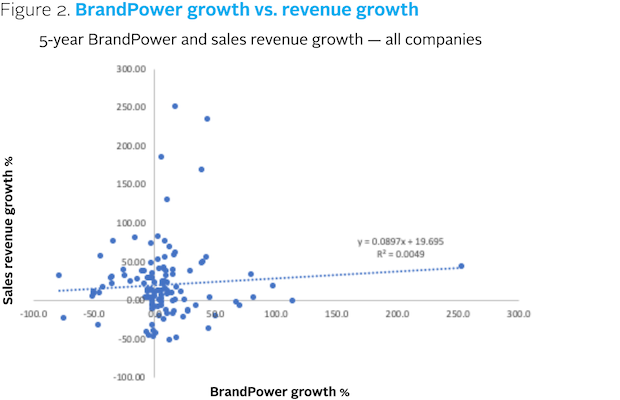
    Figure 2 below shows an overall regression analysis of BrandPower growth rate and sales revenue growth rate for all 119 companies.

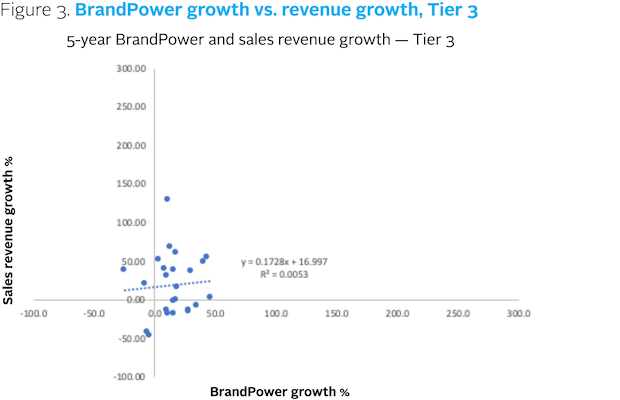
    Figure 3 below identifies the same analysis, but with only the middle tier, tier 3, companies. As can be seen by the regression conducted, the growth coefficient is nearly twice for tier three than it is for the entire group, 0.1728 vs. 0.0897. This indicates a higher rate of revenue return for BrandPower growth among the tier 3 companies than for the broader group of competitors. This result informs us that companies in the middle tier have tremendous incentive to improve their BrandPower.

    Further analysis of paid media spend and BrandPower demonstrated that as paid media increased BrandPower increased. An analysis of brand valuation showed that for an incremental paid media investment of $1 million, a $2 million increase in brand valuation could be expected. This 2:1 return on investment is a significant argument in favor of investing in the corporate brand.

    References

    Koch, C., Puckey, B., Williams, V. (2019). Empirical Findings: The Corporate Brand, Competition Forum, American Society for Competitiveness, Vol. 17, Number 1, 2019, (1-12).

    Gregory, J.R., & Wiechmann, J.G. (2001). Marketing Corporate Image: The Company as Your Number One Product. Lincolnwood, Illinois: NTC Publishing Group.

  • Now, more than ever, intention, message and tone matter

    In times of crisis, we are reminded of the fine line between offering support and capitalizing on tragedy. With the current global pandemic bringing unprecedented strife and disruption, it is more important than ever that brands maintain lines of communication—but do so in an appropriately human way. The current crisis hopefully has a relatively limited window, but the impact of how brands communicate with their audiences during the crisis can have long-term effects, both positive and negative.

    It’s about considering the frame of mind of the person receiving the information and asking yourself not, “do I want to convey this information?” But rather, “do they need to hear this information? Am I being relevant to them in this moment?” For brands, that means recognizing our shared reality, and containing your message to assurances that you are still operating, while taking all safety precautions, and therefore are still there for clients in these trying times. It may also mean reaching beyond your typical talking points, adapting your message, product or service to help solve the current need, i.e. relevance. Your tone should be compassionate and authentic, and your message focused. Note the difference in these two emails:

    (to existing customers) As we all work to navigate the ongoing effects of COVID-19, I’d like to let you know how we here at [company] are responding to the challenge and what it means for you.

    We’re very well positioned to adapt to the current crisis, thanks to a long-held philosophy of workplace flexibility and employee ownership. The team members you work with every day are equipped with technology and collaboration tools that allow them to stay engaged wherever they are.

    versus:

    (to new contact) I hope that you and your loved ones are healthy and managing through the quarantine. Things are quite interesting on my end, trying to work from home and home school two middle schoolers. The wine is very well stocked. ?

    While the world is a bit strange right now, [Company]’s top priority remains our clients. Therefore, I’m passing along this Coronavirus Insights Kit our research team has put together over the past couple of weeks.

    The first is reassuring, the second off-putting. The first authentic, the second forced.

    Communications are a key part of how we build brand presence in the mind of our clients. Brands have personalities, just like people, and messaging and tone should be grounded in and reflective of those personalities. The communications we put out now will contribute to lasting impressions beyond the current climate: a message that reads as tone-deaf or opportunistic now can undercut a carefully established strategy built around more positive brand personality attributes.

    Now is a time to be generous and considerate with each other. It is a time to demonstrate the best your brand can stand for.

  • Five ideas to help brands make an impact

    The world has dealt with a lot in the first months of 2020. Events are changing how we live, think, do business, and how we’ll move forward. Fundamentally what we have are two very different energies tearing at our norms – powers of nature thrust upon us and long-standing societal choices coming home to roost. Both are forcing brands to evolve. But how should that happen?

    As an agency that believes in the power of Brand to create positive change, we’re intensely curious about how businesses and organizations are responding. In March and April as coronavirus brought confusion and fear, we looked on, a little underwhelmed as brands adopted safe playbooks offering eerily similar messages with somber music, empty highways and refrains of “we’re all in this together.” But with time, many began to translate good wishes and hopes into action by helping local communities, finding ways to protect workers’ health and income, and start serving their customers again.

    Today, coronavirus remains an ever-present danger, and brands are discovering the potential positive impact of a coordinated Black Lives Matter movement. Ultimately what we hope to see brands do, and what we advise clients to aim for, is commit to more than superficial change. Right now, we want to see brands take a leadership role by promoting discourse on systemic racism proactively, not only when their actions, communications or logo is called into question, or because other brands have done so.

    Why though? Why do brands have a role to play in advancing social justice? We believe that as brands have evolved, creating deeper connections with consumers, having a personable voice in social media, asking us to consider them more human, they have responsibility to be more human and help move the rest of us humans forward.

    As always, the best examples of brands in action are those making decisions through their brand lens. They ask, “applying our core values to the present moment, what are we capable of beyond our product or service?” “How do we align with our customers’, executives’ and employees’ stance on the issues?” “In our lane, what slack can we pick up? What can we do, functionally and emotionally, better than anyone else?”

    As your brand weighs short- and long-term strategies, here are five critical actions that can guide you through the rest of this year and beyond:

    1. Aim for substance
    The easiest, quickest changes to make are at the surface. But we don’t advise stopping there because superficial tweaks in your brand communications or token actions don’t have the power to bring people along to your point of view. That’s hard work, true, but it can reap the greatest rewards in terms of making progress. NBCUniversal committed to a workforce made up of 50 percent people of color, 50 percent women. That’s impressive. Substantive action doesn’t have to be changes to workforce, logo or name (more below) but can go to the root of the problem. Netflix pledged to shift up to $100 million to banks and initiatives that serve Black communities. The potential impact is massive, helping make loans available to people who, historically, haven’t had access to investment capital. That’s a substantive change.

    2. Be true to you
    When looking for rules to play by, start with your brand. That’s why it was created, to establish traits and values that can guide your brands through whatever comes your way. If you don’t have a thoroughly thought out brand strategy that accounts for unforeseen scenarios, now is the perfect time to set down how you believe you should act during crisis or societal unrest. No brand could have planned for current events prescriptively, but strategically you can create a proactive brand that grows and provides a strong foundation from which to lead when the unexpected arrives. Because it will. We recommend your planning going far beyond reactive crisis communication, adopting aspirational thinking, and taking a hard look at the changes you need to make to live your values. Ben & Jerry’s progressive brand values emphasize deep respect for people inside and outside the company. While their reaction to George Floyd’s murder was extraordinary and unexpected in its detailed call for police and legislative reform, it was 100% authentic to what the brand stands for.

    3. Re-align brand values with customers’ and employees’
    Even brands led by charismatic frontrunners cease to exist without customers who share their passion and employees who bring the brand to life. That’s why it’s important to have a pulse on your customers’ POV and act on it. This isn’t a question of aligning with customers whether “they want change” vs. “they are cool with the status quo.” If your customers come down on the side of an issue that goes against your best moral judgment, it’s your opportunity as a public-facing entity to change hearts and minds. NASCAR recently angered some fans by banning displays of the confederate flag. While it may have been a calculated effort to gain brand awareness and expand its audience, we applaud it equally as an effort to bring a different perspective forward.

    The most effective organizations are those in which the leaders and employees share the same beliefs, this is how trust is created and it applies to day-to-day business, as well as social issues. This moment is an amazing opportunity share corporate beliefs and get people on the same page.

    4. Lead society forward
    Brands don’t have to be as outspoken as Ben & Jerry’s to inspire progress. For decades, Land O’ Lakes, Aunt Jemima, Uncle Bens and others felt pressure to change racially offensive logos and names. 2020 is their time to act, hopefully bringing awareness to institutionalized prejudice. After Quaker Oats decided to rebrand Aunt Jemima by removing her image from packaging, NPR spoke to the niece of one of the women who served as the inspiration for the illustration, Lillian Richard. In the piece, she shared concerns that her aunt’s contribution to the brand will be erased, forgotten.

    But what if Quaker Oats had taken it on themselves to talk to Richard’s family, and those of other brand ambassadors? The niece made a strong point – Richard’s was extremely proud of her role as Aunt Jemima at a time when few women worked, and even fewer black women could have had that level of visibility. Was it the right kind of visibility? Richard’s niece says she backs the logo change, but wishes Quaker Oats had started a conversation that could have celebrated the contribution women of color made to the brand. The situation is still evolving, and after consideration, we’d advise the brand to pick up the conversation where NPR left off.

    Also evolving is the future of the Cleveland Indians and Washington Redskins. As the franchises take action (the Redskins have announced an interim name, the Washington Football Team, while the renaming project continues), it’s an opportunity to promote new beginnings, renewed energy and cultural relevance. The teams can claim not just being on the right side of history, but being part of this moment in our history by recognizing and building awareness for the Native American groups that have long been their symbols. How many organizations wish they could generate this much conversation around their brand, or be as relevant to the conversation?

    While the changes to Aunt Jemima, the Washington Football Team and others are significant, product rebrands and even team name changes occur regularly, and consumers and fans still show up. Their success will rest on the ability to find an authentic voice that speaks to core values (new or existing) and re-build trust with consumers.

    5. Increase authenticity and transparency
    Today is also the perfect time for brands to come clean and publicly right wrongs they’ve made in the past. There are many examples to pick from, but the NFL is an easy one. In early June, the San Francisco 49ers told us that Black Lives Matter to them which is a step in the right direction. But there’s more that we’d recommend the brand do, given its past with Colin Kaepernick who they planned to release after he famously put police brutality awareness on the 50-yard line.

    At the same time, the league itself apologized for not doing enough to hear players’ concerns on racial inequality. They’re moving the ball up the field, but critics say they’re not quite there yet. What could win them over? Trust may be forward looking, but it’s based on the past. The NFL will have to loudly proclaim its renewed values and live them every day. As the adage goes, actions speak louder than words.

    Our advice on authenticity applies across the board for organizations’ well-intentioned reactions as well – they have to truly believe in something and commit for the long-haul. For instance, it’s encouraging to see company’s make Juneteenth a paid holiday this year, but if it’s not based on larger plan for promoting equality, awareness and education, the meaning risks getting lost.

    People want to know what your brand stands for now Today, brands have made great progress becoming more human, allowing consumers a connection beyond products and services. What this means though is that people are more aware of how an organization’s actions jibe with stated values, and are not afraid to call out or cancel brands. This should not strike fear into brand managers, but demonstrate the opportunity to deepen affinity.

  • A Brand New Look at the Election

    A Brand New Look at the Election

    There was much to keep our attention during this election season. As a result, I found my professional role as a brand strategist inserting itself into my personal role as a voter. My natural tendency was to glean where I saw brand concepts playing a key role – in our perceptions of the candidates, their platforms and the multitude of consumer businesses that chose to get involved.

    Personality drove brand perceptions

    A strong brand positioning integrates both positioning attributes and personality attributes. Shorthanded, positioning integrates both what you say as well as how you say it or the tone of voice. This construct was evident by both candidates’ positioning, whether by intention or by perception. In addition to their differing policy viewpoints, which in large part, define what they say or what they stand for, President Trump and President-elect Biden have distinctly different personalities. While some of that personality is an extension of their party’s platform, much of it is inherent to who they are or who they chose to appear as to the electorate.

    This difference in personality became highly relevant as the election became about identity over policy. Their identities (or personalities) defined the brand of each candidate.

    Trump’s core supporters see him as aggressive, a bold outsider to the system, and fighting the good fight. His detractors see him as self-serving, dishonest and reckless. Biden’s voters see him as “not Trump.” His active supporters also define him as authentic, experienced, a stalwart (having gracefully persevered through a lifetime of tragedies) and sincere. His detractors see him as an entrenched insider, outdated and weak. The narrative for this election was essentially cast as a good versus evil storyline. Which candidate was good and which was evil was defined by how you perceived their personality, and thus, their brand.

    Platforms defined campaign slogans

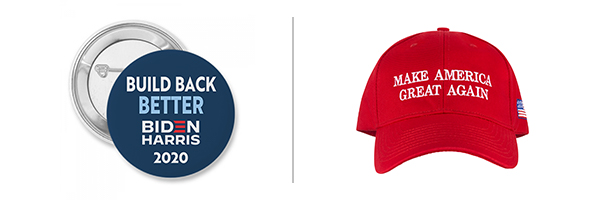
    For each candidate, multiple slogans were used at varying points over the campaign. Trump brought forward his ubiquitous 2016 campaign theme, “Make America Great Again,” as well as others such as “Law and Order” and “Promises Made, Promises Kept.”

    Biden launched with a “Battle for the Soul of the Nation,” later introduced “Build Back Better” at the Democratic National Convention and complemented with other ideas, including “Unite for a Better America” and “Our Best Days Still Lie Ahead.”

    For me “Make America Great Again” rose to the top as the core reflection of what Trump’s campaign stood for in the eyes of its supporters. Biden’s slogans were less sticky and no one slogan seemed to identify the campaign.

    Reflecting back to what defines a brand positioning, these slogans are a distillation of “what you say.” In essence, they serve the same role as a tagline.

    A tagline is an external expression of an internal brand positioning. It can serve as a rallying cry for employees or in this instance, for supporters. It offers a compelling shorthand for the positioning, and if done well, is concise, memorable, relevant and differentiating.

    Whether or not you agree with the position that underlies these slogans (taglines), most are objectively successful from a brand standpoint. “Make America Great Again” is deeply embedded in the Trump ethos. It emotionally ties the campaign to its supporters. It’s memorable. And it certainly became a rallying cry. That said, I do question the use of the same tagline after four years in office. It seemed like an evolution to “Keep America Great” was attempted, but didn’t stick. This in itself reinforces the strength of the original tagline.

    For Biden, “Battle for the Soul of the Nation” was his best effort at creating a powerful emotional connection. “Build Back Better” never attracted quite the same level of emotion, but structurally, its memorability is enhanced by the alliteration. And tactically, it was tied to every Biden proposal from jobs and economic recovery to racial equity and pandemic policy. Its strength was in its consistency at all levels of campaign messaging, exactly how a positioning statement and its shorthand tagline should be implemented.

    Corporate voices demanded to be heard

    From large consumer companies to financial institutions, many brands attempted to turn votes into marketing. Boosting voter turnout, encouraging voter registration, aligning with specific candidates – many companies attempted to accomplish at least one of these objectives, often times while simultaneously selling product. Like no other election I recall in my lifetime, the number of companies and corporations demanding to have a voice in the election was near immeasurable. According to a recent article in Fortune, “over 2,200 companies stepped up their civic responsibility efforts, embracing their power to drive increased voter participation.”

    And yet, such action risks alienating a large percentage of buyers and users. Seemingly, it was a risk many companies were willing to take this election. In our article entitled, “Five ideas to help brands make an impact” we spoke about the importance of speaking out and leading society forward in a way that is authentic and true to their brand platforms. I’d argue that many companies took that advice when considering their election-related outreach.

    For Gen Xers (like me) the first corporate election initiative that comes to mind is likely MTV’s long-standing “Rock the vote” partnership. For 30 years, MTV has been partnering and funding this high-level initiative to encourage voter registration. It is impossible to separate MTV from the program, as it’s become an authentic part of what the company stands for.

    This year sports leagues, most especially the NBA and its players, complemented MTV’s work with initiatives to encourage voter registration and enable voting in their stadiums. A natural outcome of players’ outspokenness and powerful actions in support of Black Lives Matter and in direct response to the shooting of Jacob Blake in Kenosha, these get-out-the-vote initiatives seemed natural and authentic. And more than any other sport, the NBA players’ voices combined and elevated to the league level.

    Other companies got involved by giving employees time off to vote. JPMorgan Chase, Coca Cola and Twitter, among others, ensured that at least one of the boundaries that prevents people from voting was removed. It’s an action that demonstrated leadership, I believe, in hopes that others – and perhaps the federal government – will follow.

    And in yet another effort that one might cynically describe as less generous and more aimed at selling product, many fashion companies united behind the “I am a voter” campaign by offering for purchase a mix of approachable and high-end products featuring the slogan. The outreach is defined as a “public awareness campaign that aims to create a cultural shift around voting and civic engagement by unifying around a central truth: that our democracy works best when we all participate.” Bringing together fashion and social media with designs from the likes of Stuart Weitzman, Jennifer Meyer, Tory Burch and Grayson, ensured the importance of voting was emblazoned on celebrities, influencers and everyday folk across the country. If nothing else, awareness was raised.

    Perhaps this election was unlike any other. And it looks like it may continue to be. As you tire from the rhetoric, distract yourself like I do, by finding where brand is playing a role.

  • Elevating brand ROI to a science

    Elevating brand ROI to a science

    “Data science” is a term unfamiliar to most marketers. I believe it should—and will—be given more attention because in my view it can be a true game-changer. This highly evolved form of analytics can, if employed properly, open the door to new actions that optimize the return on brand investment.

    To improve ROI look forward, not back

    When CMOs think of ways to optimize ROI they generally turn to tried-and-true metrics. What was the response rate on a campaign? What net promoter scores are we achieving? How many clicks is the website getting? Measurements such as these are valid, but they all have one thing in common: they’re retrospective.

    Marketers look at dashboards and reports, and use that historical data to decide what to do next. That’s the way it’s always been done, but it’s as much art as science. It’s future planning based on hindsight.

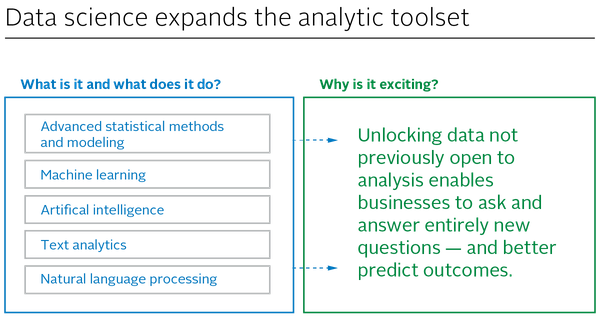
    What intrigues me about applied data science is its potential to proactively solve targeted business problems. Adding machine learning, AI, unstructured data and models that leverage these new elements to structured operational data opens up completely new areas of exploration, making it possible to predict the future more confidently and forecast more accurately. It’s a shift from understanding what happened to understanding why it happened: going beyond correlation to reveal causation.

    This predictive foresight is a fundamental driver of improved ROI on brand investments. Using evidence-based prescriptive intelligence to drive action brings the solution closer to the challenge. That boosts effectiveness from the outset, meaning less money spent for more benefit.

    Let’s take a look at a specific example: customer churn. What specific actions does a business have to take to boost retention? An analysis of customer attributes and the actions they’ve taken reveals something about the those who leave compared to those who stay, but that macro-level insight is very broad. Digging in to both the structured and unstructured data, however, can help marketers connect the dots and change outcomes. Spotting an unhappy customer early makes it possible to take preventive steps before that customer leaves…and may even prompt that customer to become a brand advocate, simply because the company came through in a pinch.

    Getting ahead of problems can have effects that extend across the business. It’s about more than driving sales or improving retention. It might be a manufacturer tracking problem reports to predict warranty claims, or a bank being able to spot anomalies and abnormal behavior to combat fraud. All of this ultimately comes back to the brand because how a business responds to challenges has a real impact on reputation: the brand benefits from the halo effect of a better-run business.

    To better meet your customers’ needs, listen to them

    There’s a treasure trove of useful information in the voice of the customer, contained in everything from market research and survey responses to emails, chats, reviews and customer service transcripts.

    What data science allows CMOs to do is marry those open-ended comments with operational data to generate insights not typically available from structured data. The voice of the customer adds vitally important context.

    There’s a lot of promise in the natural language processing space. By using machine learning and AI, it’s possible to uncover trends and patterns in speech and how people are talking about you. What’s the buzz on social media about your brand? What’s the reaction to your latest product announcement? Are people singing your praises or taking shots at you? Taking these learnings from the realm of random anecdote to rigorous analytic insight and linking actions to outcomes can be an incredibly powerful strategic planning tool.

    You can start from anywhere

    The sophisticated capabilities described here may seem inaccessible, but that’s far from the case. Data science is inherently scalable because it’s a methodology, not a rigidly defined solution. Whatever data is available can serve as the core of an emerging data science capability. For example, customer reviews are available across ecommerce platforms but the scale and complexity would be hard to resolve insights. Using AI and Machine learning is both time and cost efficient, and in this case, get marketers closer to the voice of the consumer. Traditional research methods just can’t achieve this level of efficiency.

    Data science extracts relationships between variables in a way that simply is not possible using reporting and planning tools such as spreadsheets. It’s about taking available data and mining it in a new way to get at what’s driving the outcomes that traditional methods are already reporting. Making more data available and adjusting the models accordingly extends the potential.

    Unanswered business challenges are the true starting point. Experience has shown us that businesses are sitting on a wealth of information, but that the value of that data often goes unrecognized. They have questions that seem impossible to answer, while in reality everything needed to find the answers already exists—it just needs to be looked at in the right way.

    There’s more to explore

    Tenet Partners has a Data Science practice for marketers, rooted in advanced analytics and driven by analytic expertise. To find out more, visit our Data Science offering page.

  • A message from our CEO

    WELCOME TO TENET’S 2020 TOP 100 MOST POWERFUL BRANDS REPORT.

    Few moments in our lives, careers and even mankind’s past are truly remarkable. The 2020 pandemic is our moment. Disease and uncertainty have halted life in every corner of society, reshaping and reorganizing economies and ecosystems over one of the shortest periods in history. Each shift profoundly impacts us all. This report, while looking back into 2019 and early 2020, aims to help leaders consider the changes that will impact their companies, specifically the corporate brands.

    For over 25 years, Tenet has tracked corporate brands through the longest longitudinal study of its kind. This body of work drives the only exchange traded fund that seeks unrealized value in corporate brands, guides CMOs, CEOs and boards, and helps brand managers understand how communication investments impact company value.

    This year’s report, and the supplemental report coming later this year, have special importance to our team. For 2019 and Q1 of 2020 leading into the pandemic, corporate brands were at their highest BrandPower and brand valuations in our research’s history. Apple, Microsoft, Amazon and others achieved enterprise valuations that seemed impossible a decade ago, lifting many boats with them. With few exceptions, brands have enjoyed a robust time of growth.

    Today, we see vast swaths of winners and losers in the pandemic. What is interesting, and unique in modern history, is witnessing many industries face dramatic headwinds while others rise to newfound dominance. It may take years to close the divides between the haves and have nots, if it’s even possible.

    Pre-pandemic, consumers had settled into strong B2C and B2B brand relationships. And, in a heartbeat, those relationships shifted. What was essential, was no longer. What is essential now, is redefining our take on companies and their existence. Many consumers are choosing new brands as essential to their lives in this moment. And, craving ones that they have been forced to put aside. Lastly, they’ve deemed new brands as essential to them going forward. The essential brand is the essence of this year’s report. We hope that no matter where you are on the continuum of being essential, that these strategies can help all companies create sustainable competitive advantage and resiliency.

    This report is a pre-pandemic snapshot — our follow-up later this year will look toward the other side of the recovery. Both reports will provide CMOs and brand leaders sound guidance to re-center and move forward.

    Hampton Bridwell
    CEO, Tenet Partners

  • CPG brands remain prominent in Tenet Partner’s 2019 Top 100 Most Powerful Brands study, but slipping

    Losing relevance vs. more digitally-oriented brands

    The traditional CPG powerhouses are facing unprecedented challenges due to shifting consumer usage and purchase preferences, as well as technology advances impacting global commerce. Our recently released report, 2019 Top 100 Most Powerful Brands shows CPG brands remain prominent in the rankings but are slipping. The data used in the report is derived from our CoreBrand Index which calculates a company’s brand strength, or, as we like to call it, “BrandPower.”

    BrandPower is a weighted composite of Familiarity and Favorability metrics, delivering a single benchmark for brand strength and its ability to impact business results. This metric, expressed as an index, has been validated by the Marketing Accountability Standards Board (MASB) and tracked for over 25 years.

    Among this year’s Top 100 are 17 consumer packaged goods (CPG) brands, including both food & beverage as well as personal care & household products brands, 7 of which fall within the Top 20 (with 3 in the Top 10). Among these 17 brands, Clorox (+32 spots) and P&G (+18 spots) have seen the most improvement since 2014 while KraftHeinz (-49 spots) and Tyson Foods (-33 spots) have experienced the steepest drops in ranking over that same time period.

    Coca-Cola retains the top spot overall!
    First among the CPG brands – and first among all brands in the Top 100 – is Coca-Cola, which retains its #1 spot for the 18th consecutive year. This perennially iconic brand continues to excel through consistent brand investment, excellent execution, and strategic communications to deliver stability to its brand and its investors. That said, #2 ranked Apple is nipping at its heels, having closed the BrandPower gap between the two from 2.1 to 1.3 points.

    PepsiCo and Hershey round out Top 10
    Rounding out the Top 10 are PepsiCo at #6 and Hershey at #9. PepsiCo has moved up a spot vs. last year due to strengthening of Familiarity and Reputation metrics, while Hershey has slipped several spots from #5 in 2018 and #2 back in 2014, driven by declining Investment Potential. Both have been overtaken by the rise of tech giants Apple, Microsoft, and Alphabet (Google), with Facebook and Amazon not far behind.

    Kellogg’s, General Mills, Colgate-Palmolive and Campbell’s also in Top 20
    Also remaining in the Top 20 this year are Kellogg’s (#15), General Mills (#16), Colgate-Palmolive (#17) and Campbell’s (#19), all of whose rankings have eroded a bit vs. last year, with the exception of Colgate-Palmolive, which has remained steady. Both Kellogg’s (-6 spots) & Campbell’s (-5 spots) have fallen significantly vs. 2014, with Campbell’s experiencing a meaningful drop on our Culture of Innovation metric. This metric has been proven to improve the cash flow multiple predictability in our model from 64% to 77%.

    Nestle, Revlon, Estee Lauder, Clorox, L’Oréal, Keurig Dr. Pepper and P&G within the Top 50
    Another 7 CPG brands fall within the ranks of 34-50, with Nestle (#34), Revlon (#35), Estee Lauder (#36) and Clorox (#39) within the Top 40 and L’Oréal (#43), Keurig Dr. Pepper (#46) and P&G (#48) squeezing into the Top 50. Among this set, Clorox (+32 spots), P&G (+18 spots) and L’Oréal (+10 spots) have experienced the largest 5-year advances, while Revlon and Estee Lauder have both dropped down 11 spots over the same period. Both of these cosmetics and fragrance brands have suffered 5-year declines in Overall Reputation, Perception of Management and Investment Potential. Clorox appears to have been bolstered by growing Familiarity, while P&G shows strong long-term improvement across all tracked metrics.

    JM Smucker shows momentum, while Tyson Foods and KraftHeinz continue their steep declines
    Among the remaining CPG companies in the 2019 Top 100 Most Powerful Brands list, only JM Smucker (#54) ranks in the 50s through 80s in 2019, up 10 points vs. last year due to across-the-board improvements on captured metrics, notably Familiarity and Overall Reputation. Tyson Foods (#97) and KraftHeinz (#99) complete the CPG entries in the Top 100 for 2019. Both Tyson Foods (-33 spots vs. 2014) and KraftHeinz (-49 spots vs. 2014) continue their long-term slides and are now perilously close to dropping out of the Top 100 in 2020. Tyson Foods’ decline appears linked to having the lowest Culture of Innovation scores among those in the Top 100, with a gap of over 20 percentage points vs. the next lowest brand. KraftHeinz’s rankings drop since 2014, just prior to its formation by 3G, is the steepest of any corporate brand tracked in this study over that time period. Declines in both Perception of Management and Investment Potential are likely contributing factors.

    Company Name2019 Rank2018 Rank
    Coca-Cola11
    PepsiCo67
    Hershey95
    Kellogg1512
    General Mills1614
    Colgate-Palmolive1717
    Campbell Soup1918
    Nestlé3431
    Revlon3534
    Estée Lauder3636
    Clorox3938
    L’Oréal4340
    Keurig Dr Pepper4642
    P&G4852
    J.M. Smucker5464
    Tyson Foods9790
    Kraft Heinz9993

    ‘So what’ for CPG companies?
    The big CPG players are facing unprecedented challenges due to shifting consumer preferences and technology advances impacting global commerce. Today’s consumers seek offerings that not only address their category needs, but also align with their lifestyles. They still want consistent quality, but they also want it delivered conveniently, sustainably, and authentically – all at a fair price. Amazon has changed the game forever, lowering barriers of entry for smaller players to reach the masses, while also serving up its set of private label offerings at lower prices across an increasing number of categories. The broader democratization of digital commerce has only served to level the playing field between large and small CPG players even further. The net result is declining relevance and share for the larger, typically more established brands.

    The digital revolution is causing seismic shifts across the global economy, with the new tech giants Facebook, Apple, Amazon, Netflix and Google (collectively FAANG for short) accountable for 40% of the recent rise in the stock market and now commanding over $400 billion of brand value. Along with Microsoft, which is #5 in our BrandPower rankings, these brands are creating powerful ecosystems that not only drive the digital economy, but also siphon off professional talent and investment dollars from more mature industries like CPG.

    To stem the tide and regain their growth momentum, the CPG powerhouses will need to accelerate innovation efforts, creating new products, augmented services, and usage/purchase experiences that 1) align with and support their respective brands, 2) leverage emerging technologies and 3) better deliver on consumer needs and desires. Only then will they see meaningful improvement in terms of Brand Power, which in turn will help them remain attractive to both high-talent employees and financial investors.

    About the author
    Sean Folan is a Senior Partner of Brand & Innovation Strategy at Tenet Partners. He co-leads the firm’s innovation practice, which works with clients and their end-users to generate consumer-inspired product, service and experience innovation concepts through an iterative, human-centered approach called Co-Magination.

  • How to Revive Innovation in 2018

    We’ve been involved in product innovation, design and development for decades. Both on the client side and as consultants. We’ve seen first hand many of the victories enjoyed and the struggles endured by companies engaged in innovation regardless of size, industry and culture. It’s clear to us that the risk inherent in launching new products hasn’t gone away. Or even been greatly diminished. What has changed is the source of that risk and the way companies have chosen to contend with it over time.

    In several studies conducted by the Product Development and Management Association over the years, the failure rate of new products has remained remarkably constant from decade to decade.

    1980s: 42% failure rate
    1990’s: 40% failure rate
    2000’s: 46% failure rate

    A failed product is defined as one that doesn’t meet the objectives management established for it over a specified period and is withdrawn from the market. As you can see, not a promising trend. In fact, these are incredible statistics given all the strides we think we’ve made as an innovation community. Of course, different industries show different failure rates. Unfortunately for most readers here, consumer products and services show higher failure rates than commercial products. An interesting distinction that perhaps has something to do with the challenge of properly reading evolving consumer wants and expectations. As well as quick shifting tastes and trends that require rapid response—a difficult task for many organizations. The good news is that the often cited “80% failure rate” statistic appears to be a myth perpetuated by those who may stand to benefit from such a claim.

    Why, after all our advancement in methodology and process, do so many new products continue to fail? It’s reasonable to say that the standardization we impose on other business functions just doesn’t work for innovation. That which is mission-critical for Accounting and Production may not play well in the art-and-science realm of innovation. That may be part of the answer, but far from the entire story. Let’s take a look back at innovation practices through the (recent) ages and see what we can conclude about why we seem to have hit a wall.

    The 1980’s: Companies didn’t really know what innovation was, though many were doing it instinctively. 3M, GE and others were starting to measure the business impact of new products and considering “new product development” a survival tactic. It was popular to say that “X% of our revenue comes from products less than Y years old” as if that was, by definition, a good thing. Yet there was no clear, standardized approach to innovation. Companies were learning as they were doing. In this pre-methodology era, those few dedicated product development staffers were likely deported from mainstream, revenue generating business roles. And not always as a reward for strong performance.

    Back then, new products were more likely to come out of R&D and then passed along to Marketing for packaging and communications. Companies would discover a new utility and then look for ways to exploit it in the marketplace. If there were people dedicated to product development, they were likely close to the technical side, challenged to find a customer for some new skunkworks invention. There wasn’t much in the way of discipline. But there was a bunch of ad-hoc creativity. And lots of dabbling.

    It’s interesting that despite the risk inherent in this rather informal technology-driven innovation, the success rate was not abysmal. It could be theorized that risk in this environment almost took care of itself, as many of the skunkworks innovations didn’t prove out in the lab and never made it to market. And those that did were exposed to such a rigorous vetting process (and were so novel) that they likely stood a better than even chance of success. Perhaps the “hammer looking for a nail” approach is unfairly maligned!

    Even so, it became clear that the practice of new product development needed some structure. Companies were fond of systematizing work for efficiency and to eliminate error across functions. Imposing methodology was thought to be the answer. And “innovation” as a discipline was born.

    The 1990’s: Process discipline was all the rage. Standardized practices. Stage Gate methodologies and Six Sigma. Companies looked to import and install commoditized innovation methods in an attempt to minimize risk—considered the enemy of product development at the time. Organizations can’t survive without structure and process. So we asked the obvious question: Why can’t we automate innovation down to a zero error rate?

    Well, we learned a few things in the 90’s: First, innovation is a blend of art, judgement and science. While we talked ourselves into believing that these ingredients are ripe for systemization, our efforts to do so underestimated the resistance natural creativity has toward any attempt to instill order. And while imposing rigorous process on innovation made everyone feel safer, it didn’t do much to ameliorate risk or improve success rates, as we know. But we did get a lot better at stopping things that appeared unpromising. But it’s not clear we were necessarily green-lighting the right initiatives.

    Second, we learned that a year’s worth of standardization was in fact putting a choke hold on innovation. Production assets were designed decades earlier to do one thing really well: Fill this specific bottle with that specific goop. So now we have this early focus on innovation, people to staff it, methodology to guide it but not enough latitude to deliver on it. Frustrating.

    Process, in conjunction with a lack of asset flexibility (ironic since process inherently limits flexibility as well) resulted in a desolate landscape for innovation. Great ideas were contorted to run on existing lines. And their salience suffered, victims of what we might call “Adaptation Risk”. Success rates stagnated. Methodology got the blame, but it was no one’s fault. The machines chunking out soap and cheese were paid off long ago. And no one wanted to pay to replace them. The tension was building.

    The 2000’s: Design consultants save the day. Sort of. Companies decided they need outside help in cracking the innovation code. Design firms proliferated to address the mounting frustration internal methodology has left behind with copious amounts of creative energy. Some firms forwarded their own methodologies for those clients late to the discipline table and in need of that security blanket. Others promised raging creativity that internal staffers presumably couldn’t muster. And yet others dug deep into client production facilities looking for ways to squeeze a drop of flexibility out of those machines built to do one thing really well, really fast.

    This was, in an odd way, the golden age for innovation. Many companies recognized that process discipline wasn’t the solution it promised to be. And we learned that risk could be a good thing. The power of creativity was winning favor on both the marketing and manufacturing sides. Those in innovation roles began to earn respect and were chosen for a set of personal and professional attributes that seemed to align with the welcomed uncertainty of innovation.

    Management started—we say started—to become comfortable with risk and the notion that not all new products succeed. And that failures provided learning to feed later success. In fact, there was a certain misplaced pride in failure until management realized there was only so much failure an organization could enjoy without an occasional knock-out success to pay for it.

    This, we believe, was the start of “Design Thinking” as we know it today. When companies can recognize failure as part of an iterative prototyping effort and can value the kind of user empathy that internal market research wasn’t providing at the time, we knew we were making real progress. Now, if companies could only learn to iterate and fail before launch…

    The 2010’s: The smart money knows it’s not about “product” anymore. It’s about the story. The experience. The BRAND. Gone are the days of utmost concern about the new functional benefits consumers demand from products. It’s not enough to leapfrog competition with features we think we know consumers want. Consumer wants have been replaced by Need States: The emotional underpinnings that drive choice. People out there are too busy to discern why one product may be better than another without taking the time to experience it. So benefit-driven messaging no longer wins hearts and minds. And in most categories, those hearts and minds don’t care enough.

    What they do care about is affiliation. Experience. Values. The absence of frustration. What does that mean for innovation? Tons. Now, innovation is about making a promise to consumers that resonates. That reflects who they think they are and what they want to say about themselves. And doing a job they care to get done with confidence and style. So, it’s the holistic offering that will win the day. Not just a new package. Not a new flavor. But the integration of everything we used to think of independently. Together. It’s about The Story.

    As a consumer product, how does aesthetics, formulation and utility come together in integrated fashion to deliver a coherent brand promise? As a service, how must all the brand touch points behave to achieve performance and satisfaction? Key questions: What’s the difference between product and service in this new order? Answer: Not much.

    How does a brand set parameters, provide latitude and profess values to guide new product and service development? Or better yet, become product development. It’s not about the “thing” anymore. It’s the experience. Sure, technology plays a facilitating and exciting new role. IoT for instance enables change and utility like nothing we’ve seen before, with the potential to upgrade convenience and lifestyle. But it’s a “how”, not a “what”. The “what” remains that need state fulfillment grounded in a satisfying experience, however delivered.

    Why is this tectonic shift in the definition of “new product” so important to acknowledge? While this turn of events tamps down certain kinds of risk in innovation, it elevates others. And for companies, innovation has always been about risk. Now, there are more kinds. Where today’s innovation can ride on the strength of a brand and diversify across multiple touch points, its chances of success can be greater. And its costs can be lower. But—and this is a big one—in this day and age, a brand innovation story is subject to incredible scrutiny (and brand abuse). Much more so than a new feature set or package form.

    Think about Dove’s recent stab at bringing the brand to life in an array of body-shaped bottles. In hindsight, it was easy to see how this would go wrong. A brand’s values are just that—values. They cannot be literally translated into a package form or any other physical manifestation. They tell a story—they don’t dictate product. Why dwell on poor Dove? Because in an attempt to define a brand message in the merging of new and old innovation paradigms (story meets design), they achieved nothing. That, coupled with a few thousand haters with the hand-held technology to make their feelings known can upend innovation like nothing has before it.

    However, in an age where Tweets, stories, and pins are exchanged with lightning fast speed, companies can find a logical application for social media in the ideation and crowdsourcing phase of product innovation. There’s a definite draw for brands to use social media to replace some kinds of market research. However, brands struggle to find the right strategy.

    Oftentimes, data from samples on social media can lead brands astray. There’s just too much of it and a lot of noise that comes with it. So, they’re relegated to “testing the waters” rather than to dive in completely. Why? Social media is an intrinsically consumer-focused and controlled channel. It gives consumers the freedom to express their feelings instantaneously, creating an emotionally charged environment where users are quick to react to experiences that either exceed or fall short of their expectations.

    And, there lies the problem. Sharing and posting on social media is driven by emotional extremes whether negative or positive, which can make social data a bit unreliable. And it’s often the unqualified negatives that can torpedo a new product on emotional grounds before it gains momentum. One could call this “Hater Risk”. It’s important for companies to track not only the quality of the social data, but also the qualifications of the participants who provide that data. Identifying subject matter experts leads to the best expertise and increases the quality of insight for innovation. It’s all about listening to the right kind of data from the right kind of users while tuning out distractions, which is easier said than done.

    While the risk to innovating has changed, it hasn’t diminished. As we pointed out, the proportion of successful new product launches has remained roughly constant since the early days. Why is that? We think it’s because:

    1. We still face rigid actionability parameters in many companies. So we focus attention on the near-term little wins at the expense of category transformation. And the best ideas are often truncated to fit the parameters allowed by existing assets. One would think those little wins have a better chance to succeed. But we’d guess that incremental change does more to mess with a winning formula than it does to improve it.
    2. Brand extension mania seems like a risk averse strategy for innovation. We would allege that such efforts can dilute a brand’s core attributes, perhaps weakening it’s pull for consumers. So not only might brand extensions fail of their own accord, they could bring the brand down a peg with them.
    3. Cross-functional teams are great because they get things done. But they also water down great ideas. Let’s face it: If you’re representing R&D on a project team you may still be incented to push back against anything that could throw a wrench into a finely tuned production machine. And who could blame you with new product success rates as they are.
    4. As a corollary to the above, organizational complexity has created project complexity. Core teams are huge and sell-in audiences are vast. We firmly believe that minds that work alone or in very small groups have the best chance of surfacing the truly transformational. That’s because mandating consensus is the surest way to dumb down a fabulous idea.
    5. As suggested, consumer tastes and trends are moving so fast. Reading consumers properly and translating that insight into winning product on the store shelf has become more difficult. The science of consumer research and product development has had a difficult time keeping up.
    6. Innovation as the melding of art, judgment and science continues to—and will always—defy standardization. Period.

    We would like to think that process discipline, creative energy and risk is achieving a new, healthier balance. And that may finally reduce those intractable failure rate numbers. Perhaps the failure rate isn’t even that meaningful a measure. If you have one wild blow-away success in ten, you can absorb a lot of failure. Hollywood as learned that lesson, as they make bigger bets on fewer potential blockbusters. But there’s much to unpack in that change-of-paradigm for corporate America. In the meantime, here are a few tips for how to think about managing risk in your innovation projects, day-to-day:

    1. Leverage consumers better. Don’t “order take”. Put them in contexts that allow them to do what they do best. And use what you see and hear as inspiration—not direction—for concept development and refinement. Talk to us about our Co-Magination approach. It’s a collaborative tool set that’s fast and flexible enough to avoid the rigid process trap and the pitfalls of taste-and-trend whimsy.
    2. Don’t let process discipline choke off creativity. Reverse course. Deviate. Meander. Just don’t get lost. Remember: You manage the process—not vice-versa.
    3. Use the brilliance of the single creative mind to your advantage. And then incubate it in close quarters until it has matured before letting it loose on the organization.
    4. Don’t skip the design strategy phase where you assimilate defensible consumer insights (not evident observations) and chart specific innovation platforms. Use tools that focus creative energy, build team consensus when necessary and crisply communicate a path forward.
    5. Be careful when concept screening. Many breakthrough ideas fall to the ground in the earliest stages because as initially presented, they don’t appear actionable or have too many moving parts and confuse consumers. In other words, rethink the “concept board”.
    6. Iteration is your friend. Test and refine, test and refine, then test and refine. See #1 above.

    So how can companies change the consistent flatlining of product success that’s plagued innovation for decades? There are two ways to go. Option one: Winners have to be bigger. Which means risks taken must be greater. Therefore, companies must be open to the heightened internal and external scrutiny that comes with misjudgment—fair or not. Doesn’t sound great.

    Option two: Decades of circumstantial evidence points to an inability to read consumers as the largest thorn in the side of innovation. Sure, new product development has got to get faster. From ideation to production, there’s no time to waste. But that’s not enough. Tastes and trends come and go. But our new need state order remains fundamentally the same.

    So focus on surfacing those underlying emotional triggers that may evolve slowly but don’t dramatically shift. Then, craft a story that’s much bigger than the singular dimension of new product success. And bring that story to life in redefined brand-relevant experiences that provide meaningful context (and content) for products and services rather than letting them hang out there all alone.

    Can we break trend and revive innovation success starting in 2018? Certainly. We think the best way to do that is to rethink the role of consumers in your projects and the tools you use to engage with them. If we’ve learned anything over the past 30 years it’s that traditional research and creativity methods can reduce a project to a hit-or-miss proposition. This year, why not better your odds.


  • The biggest branding shifts of 2015 – and what they’ll mean for marketers in 2016

    With the New Year upon us, many have taken the time to reflect upon the changes of the past year. Given just how quickly the worlds of advertising and marketing move, it’s important to take stock of the drivers that continue to shape and influence the way brands create value, both for their organizations and their customers.

    ‘Innovation’ and ‘disruption’ seemed to be the buzzwords of 2015, but for all the noise these catchphrases have created, it’s worth asking: Is brand innovation and disruption simply a trend or part of something bigger? My vote is for something bigger that is fundamentally shifting our relationship with brands and the experiences they create. In the spirit of reflection, here are five major ways the branding landscape evolved in 2015, and what these changes will mean for marketers as they seek to create new and ‘disruptive’ brand experiences in the year ahead.

    The shift from the connected consumer to the connected product
    The rise of the Internet of Things (IoT), coupled with the growing spotlight on Design Thinking – a form of customer-centric design – has resulted in products never before seen. In the race to build the first truly connected smart home, Apple’s HomeKit will be going head-to-head with Amazon’s Echo – and despite being at the center of a few April Fool’s jokes when it was introduced, Amazon’s Dash Button illustrated, if anything, that the IoT is poised to create profound changes to the way consumers shop both online and off. In 2016, the biggest challenge for brands won’t necessarily be in creating a new suite of connected products, but in transforming them from novelties to true utilities, offering a functional as well as an emotional benefit to the end user.

    Apparel stands out as a category prepared to make transformative shifts on this front. While clothing with sensor technology is still in its infancy, major brands including Under Armour, Ralph Lauren and Levi’s have been working to develop their offerings. Ralph Lauren revealed its smart shirt, PoloTech, at last year’s US Open tennis tournament, made with a “second-skin” fabric that tracks biometric stats like heart rate, steps taken, breathing depth and energy exertion. Many leading brands, from Apple to Google and Nike, are also investing in artificial-intelligence technology that reads people’s emotions by analyzing facial expressions – expect major things on this front from hyper-targeted advertisements to virtual dressing rooms and virtual personal shoppers as part of the in-store experience.

    Brands as content creators – and social media’s growing foray into e-commerce
    2015 was a banner year for content marketing. While continuing to disrupt the hotel industry, Airbnb’s one-off print magazine, Pineapple, made headlines and the company is now in talks with Hearst to launch a new magazine as a joint venture.

    On the traditional hospitality front, Marriott’s in-house content studio expanded to take on film. In March, the company launched its first original short “Two Bellmen,” a 17-minute action-comedy starring Henry Simmons from Marvel’s “Agents of S.H.I.E.L.D” and Miles Brown from ABC’s “Black-ish.” David Beebe, Mariott’s VP of creative content and global marketing who leads the 65-person studio, explains Marriott’s approach with three Cs: “Scaling content, then building a community around that content, and driving commerce.”

    Driving commerce with content marketing will be high on marketer’s to-do list in 2016. According to the Content Marketing Institute, approximately 80% of B2C marketers plan to produce more content in 2016 compared to 2015. In the B2B space, 51% of marketers plan to increase their content budget in the next 12 months.

    On the social media front, brands will be increasingly turning to Instagram, Facebook and Pinterest to help boost consumer loyalty and drive sales. Across channels, these sites are getting smarter about offering ad space and tools that allow businesses to integrate their content with images and inspirational posts, giving consumers the opportunity to purchase the products seen directly within these social pages. As social media sites grow to become micro e-commerce platforms, marketers will need to focus on four crucial components to establish their footing and keep consumers coming back for more: the quality of the content; user experience and functionality; customer engagement and community building; and lastly, brand narrative and messaging. Companies need to ensure that their brand’s personality, values and voice are “on-brand” and complement the host of experiences through which customers are already engaging with their brand – both online and off.

    Design Thinking and its movement to the C-suite
    While the concept of Design Thinking isn’t new, in 2015 we saw it become more fully embraced by the C-suite. No longer just revered by product and service designers, C-level executives are now applying the principles of design to better manage change and help solve some of their most pressing challenges. As Indra Nooyi, PepsiCo’s CEO aptly said in an interview with *Harvard Business Review*, “Design leads to innovation and innovation demands design.”

    Nooyi stepped into her role as CEO in 2006 and in 2012 she hired Mauro Porcini, the company’s first-ever chief design officer, to oversee design-led innovation across all of PepsiCo’s brands. Porcini has been instrumental in launching the first output of Pepsi’s design-thinking approach, the Spire family of vending equipment that allows customers to customize their choice of beverage, adding flavors and suggesting new ones with every purchase.

    Tech giant IBM is also on a mission to transform its corporate culture and service offerings by instilling a Design Thinking mentality throughout the entire organization. “There’s no longer any real distinction between business strategy and the design of the user experience,” said Bridget van Kralingen, the senior vice president of IBM Global Business Services, in a statement to the press. By the end of 2015, the company brought on nearly 1,110 new designers, recruiting from top schools including Stanford, Carnegie Mellon, the Rhode Island School of Design and Parsons School of Design and is continuing to train employees across functions on how to apply design thinking to business strategy.

    Innovation by Collaboration – the growing importance of brand partnerships and its impact on business success
    As Tenet Partners examined in its 2015 Top 100 Most Powerful Brands report, some of the fastest-rising brands invested heavily in R&D, strategic acquisitions and collaborative brand partnerships. As technology continues to blur industry lines, companies will increasingly turn to sectors and categories outside of their immediate category, not only seeking inspiration, but also to forge more meaningful connections with audiences by driving innovation to generate business results.

    Take Google, for example. Before it announced a restructuring effort to become Alphabet, the company acquired smart home product manufacturer Nest. In March, Google announced plans to partner with Johnson & Johnson to create a robotic-assisted surgical platform. Both moves crossed category boundaries in an effort to generate new value. In another teaming of two very different organizations, IBM and the Institute of Culinary Education (ICE) teamed up and launched a cookbook, *Cognitive Cooking with Chef Watson*. It was the result of a three-year partnership that brought ICE chefs and IBM researchers together to explore data’s effect on creating the perfect recipe.

    Collaborations such as these illustrate that in order to thrive, brands cannot go it alone. Strategic partnerships that reach new audiences and enter into new categories while unlocking value for businesses, customers and shareholders will serve brands well now and well into the future.

    Brands responding to political and social events – finding support, not backlash
    As brands continue to engage in the places where their customers are, most notably online, it’s become second nature for brands to respond in real time to the most hot-button political and social news stories of the day – a bold new idea for the brand marketers of yesteryear.

    In June, when the Supreme Court announced a historic ruling legalizing gay marriage across the country, brands hailing from the technology sector, financial services, retail and consumer packaged goods industries were quick to voice their support, meeting the admiration and “liking” of their customer base. The tragic terrorist attacks in Paris last November also resulted in a quick response, with brands adopting the #peaceforparis hash tag and logo created by French graphic designer Jean Jullian along with other expressions of solidarity.

    However, not all brands that jumped into political and cultural dialogues received positive reactions. Starbucks’ “Race Together” initiative was met with a wave a criticism when it was launched. The campaign – which aimed to spark a national conversation about race relations by having baristas write the phrase “Race Together” on Starbucks’ cup – was seen as an ill-conceived attempt at engagement, incapable of bringing about meaningful or lasting change.

    As brands continue to take on political and socially charged issues, whether in the form of 140-character tweets or as a comprehensive corporate citizenship program, my predication is that they’ll be more attuned to incorporating their unique brand DNA and positioning into the experience. Execution will be everything and the right balance of authenticity, engagement, and responsiveness will go a long way in creating memorable engagements that win the hearts and minds of consumers, whether it’s through clever and emphatic alterations of their logo or homepage, or inviting consumers to participate in their effort through user-generated content.