Category: Blog

Tenet Blog

  • Merging Genre-Defining & Bite-Sized User Experiences

    Activision Blizzard’s acquisition of King Digital is worthy of discussion in regards to how they’ll blend their complementary brand strengths. Activision Blizzard has a strong player community and genre-defining content, while King Digital provides a wider audience through all-ages and bite-sized content. An important facet of this joining of brands is their respective user experience styles; actively engaging their audiences through quality content.

    Defining Genre Experiences
    While Activision Blizzard has a solid handle on community building through expansive multiplayer and online games such as Call of Duty and World of WarCraft, there’s more to their products than just playing with others. Most of their products have games within games. These non-required quests, challenges and mini games are opportunities for players to do more than just button mash to the next level.

    Their games have “replayability”; there is more content than can be consumed in just following the primary missions or story lines. It’s encouraged to explore the worlds they’ve coded, seek out various achievements (challenges that provide a digital trophy for accomplishments).

    The Activision Blizzard experience is about long-play engagement with others. Unlike Candy Crush, these games can take several hours to progress through campaigns, challenges, story arcs or quests. Their content provides a lasting experience for players, while allowing for on-the-go bursts of playing time. King Digital’s games are a more focused user experience, providing quick hit entertainment for the masses. A round of Candy Crush or similar game can take minutes, not hours. How many rounds and minutes users spend at any given time varies. As most of those games have infinite rounds (although not necessarily infinite lives/turns), the potential entertainment value is limitless.

    Bite-Sized, On the Go Experiences
    King Digital is responsible for the slightly addicting matching game Candy Crush. They’ve created other games like Pet Rescue, Diamond Digger, Farm Heroes, Papa Pear, Bubble Witch and Alpha Betty. These games don’t have the story or character depth when compared to Activision Blizzard’s offerings. There’s little of that needed when the game mechanics are simplified to matching, grouping and organizing.

    They’ve been responsible for bringing casual gaming to the masses through Facebook and mobile devices. Their games help show that gaming isn’t just for “gamers” but for everyone. You don’t need to invest in gaming specific hardware or software, beyond the games themselves. They’re all-ages and more intuitive than role-playing, real-time strategy, or first person shooter games. King Digital has made a very quick impact on making “gaming” mainstream.

    Will it Blend
    Today’s games are becoming increasingly multifaceted, to accommodate the multiple playing styles, skills, and interests of gamers. With games like Witcher 3, Fallout: New Vegas, Battlefront, Grand Theft Auto: V and the Fable franchise, there are several integrated card, dice and board games within the overall games, providing an example of what Activision Blizzard could best take advantage of with its purchase of King Digital.

    Leveraging King Digital’s focus on “creating moments of bite-size brilliance” and Activision Blizzard’s roster of “pure-play interactive” entertainment, there’s incredible potential for integrating more quick-play games and community building aspects in current and future long-play games. By utilizing the depth of user behavior data both companies have, there’s great potential for finding the right balance between accessible, engaging, and replayable content.

    I’d love to see mini-games integrated into the lore-rich and character-strong games in development. It’d also be great to see it go the other direction, bringing more depth to the casual gaming with characters or story lines to progress through at your own pace. As an avid fan of Activision Blizzard’s products, and a previous player of Candy Crush, it’ll be fun to see just where this acquisition takes both companies.

  • Chipotle: Ingredients for Reputation Success

    Chipotle, once a darling of Wall Street, continues to face serious reputation issues tied to the outbreak of strains of salmonella and E. coli. In an interesting twist, it is Chipotle’s differentiating commitment to sourcing and carefully preparing the very best natural ingredients to offer “Food with Integrity” that may have led to the outbreak. Apparently, sourcing and preparing food using high-quality, raw ingredients without additives can be a risky proposition.

    Chipotle’s stock has been pummeled, leading the decline during a tough first week of trading in 2016. This is despite the efforts of Steve Ellis, Chipotle’s Chairman and co-CEO, to institute stepped-up safety protocols. Nevertheless, over the past 20 years, Chipotle has earned a reputation of being a step above the Fast Food category, creating a unique Fast Casual dining experience. While Chipotle is responsibly taking a closer look at its ingredients and preparation, there are a few reputational ingredients the company must adhere to in order to rebound:

    • Leadership must be unwavering in its message about its 20+ year commitment to creating a better dining experience through natural, healthier and better tasting options. This value proposition remains a valuable point of differentiation.
    • Transparency is key – Chipotle must “lean in” with a higher profile about the steps the company is taking to address recent health issues and speak to the results of its improved efforts. Witness what Dominos Pizza did in its food tampering scandal, how it owned up to it in high profile TV commercials and was clear about rededicating itself to its customers.
    • Engage all key stakeholders in Chipotle’s ecosystem to serve as advocates in restoring its reputation. Consider the role of employees, farmers, ranchers, suppliers and loyal customers as advocates. It’s one thing for the company to communicate, it’s quite another to have support from other constituents.

    It is uncertain whether Chipotle will fully bounce back, but they certainly should not be counted out. Many other companies have faced far more serious issues and have demonstrated their resilience by following these simple reputational ingredients.

  • Building a Purpose Driven Brand – One Cup of Coffee at a Time

    Embarking on my daily walk of 15 blocks from Grand Central to West 27th Street, I stop in one of my usual Starbucks haunts on the corner of 31st and 6th. I get my typical order of a skimmed (or non-fat as these Americans like to call it) latte (I save the tastier full fat lattes for a weekend treat) and I leave with my usual faint twinge of guilt. Guilt? But you ordered the skimmed latte! Fortunately, that element of guilt I’ve managed to mitigate; this guilt comes in the form of a white paper cup.

    Every time I buy a coffee I get it to go and every time I’m done enjoying my milky morning treat I put my used cup in one of the thousands of trashcans around the city. Each day I notice oodles of trash collectors picking up those coffee cups and each day I think of the thousands of landfill sites across the globe containing my and every other New Yorker’s or Londoner’s or any major city in the world with a coffee shop on every corner discarded coffee cups.

    Awakened Brands

    This morning I read a short eBook called Awakened Brands by Virginie Glaenzer. The book discusses the need for brands to be aware of the changing face of consumerism. Customers are becoming increasingly aware of what they buy and from whom they purchase; they are becoming more brand conscious. People are making choices about the brands they want to be associated with based on how they view the world; buying from particular brands holds meaning for them and, according to Virginie, companies are beginning to see the need to tap into the emotions of their buyers in a way they never have before.

    It seems this morning I was awakened. I realized that my morning coffee is no longer just about coffee; it’s about what I stand for in this crazy world, and I’m not the only one who thinks this way.

    Consumers are driving brand behavior

    Consumers are demanding that brands get on the eco-friendly bandwagon and, thankfully, many corporations are sitting up and listening to their needs. Organizations are beginning to raise their level of brand consciousness when it comes to the environment. One example is the US cities that have banned one-use plastic bags in grocery stores. Whether you agree or don’t agree with the ban, it’s one example of how people are becoming more conscious of their carbon footprint.

    Starbucks is one of those brands. It recycles and reduces waste, in part by its introduction of a reusable cup program. It drives and supports water and energy conservation, and it’s working to fight climate change.

    There are many more who are leading the way in providing purpose driven products for customers. Ikea is aiming to ‘think within the capabilities of our planet’ by designing furnishings that meet the increasing environmentally friendly needs of consumers. Hilton is also pushing for environment preservation by being more energy efficient, reducing waste and using renewable energies. These are three of the many companies that are making strides towards becoming more sustainable brands.

    We can all make a difference

    With consciousness in mind, today I made a stand. No more disposable coffee cups. I bought a reusable cup, and I will carry it with pride. Although my change might be a small one, the more we make environmentally conscious choices, the more we will influence the brands we purchase goods from every day to protect our world and make for a greener future.

  • Managing for Disruption – Lessons in Building Brand Clarity

    Disruption and innovation are the mantras of the day. This is not just a management fad. These have become cornerstones of competitiveness. Technology—in particular the digitization of the enterprise—is having a profound impact on today’s businesses. It is accelerating market shifts, enabling the creation of new business models.

    That’s catching many companies off guard.

    Increasingly, forward-thinking companies are redefining themselves to remain relevant. They’re focusing on their core, and shaking up the organization to allow it to evolve organically. That is what is enabling these companies to thrive in the face of rapid technological change. By breaking free of old paradigms, they gain clarity of purpose and can better understand their path to the future.

    Jeffrey Immelt, CEO of GE, summed it up nicely in a recent interview, “A company like GE has to be all about change. It has to be all about picking what’s next, getting the company focused, making the company accountable.” Immelt goes on to elaborate on a critical point, “What we’ve tried to do is narrow our focus as a company, to be only those things that have significant core competency. Being only as broad as you are deep is the way that you have to think about running your company today.”

    The journey that GE has signed up for is an uncomfortable one. Change is always messy and unpredictable, requiring new ways of thinking and doing. Distilling the company and all it represents down to core ideas is no small task.

    How Can A Brand Enable Transformation?

    Today’s companies need a ‘True North’ to guide them as they evolve—a platform to articulate a vision for the future, and a roadmap to achieve defined goals. For marketers, that means reaching more broadly across the company to help coordinate activities, and designing tools that can ready an organization for the changes that lie ahead.

    The brand is one of the most powerful assets marketers have to help the company drive change, because it can enhance understanding of the company’s scope, differentiators, target demographic and core competencies. That insight allows a company’s leaders and employees to target challenges, discover new business opportunities introduced by disruptive technologies, and take more directed action to effect real and lasting change. To be effective in this role, however, the brand must have a clear definition and purpose.

    While brand clarity is crucial to success, it cannot exist in a vacuum. It is inextricably tied to business strategy and the environment. Before redefining the brand to reflect the company’s new focus, leaders must step back, study the world around it, and craft a solid business strategy on which an evolved brand can be built. By doing so, the company will be better equipped to make the critical business decisions that lie ahead.

    Companies that fail to proactively develop their business strategy are more vulnerable to shifts in market dynamics and may find themselves blindsided by new competitors. Operating on outdated business strategies, they become irrelevant. A case in point is Kodak. Despite being the inventor of digital photography and driving most of the early innovations, Kodak failed to capitalize on new disruptive technology and lost relevance in the marketplace.

    According to Tenet’s CoreBrand Index, Kodak still has a fairly solid brand, which is something of a surprise. On the other hand, it’s hard to erase such an iconic brand. In our collective consciousness, Kodak is forever tied to our most deeply held and emotional moments—photographs.

    SEE ALSO: No Brand Is Safe in the “Age of Disruption”

    While a strong brand like Kodak can insulate a company from a few bad decisions, it can only do so much to save a failed business strategy. In hindsight, it is easy to see that the film business had strategic control of the company and that everything else, including robust digital imaging assets, were ancillary activities that were not properly leveraged. Even with a late start, Kodak had the means to disrupt its own business and save itself. And, they had the brand foundation to do it. Unfortunately, Kodak did not have the leadership or the strategy needed to make the shift.

    Read the full article on Branding Magazine.

  • When Investing in Paid Social Makes Sense

    There’s no doubt that for many marketers and decision makers, the allure of crafting a campaign for social media is the cost, or rather the lack thereof. Using social media to market for free is a natural draw for cost-conscious organizations looking to build online awareness for their brand. That said, social networks are businesses, and in looking to turn a profit they’ve built sophisticated ad platforms many advertisers have taken advantage of when crafting their social media strategies. But when does it make sense to consider paid social as an area of investment? Below you’ll find four situations I’ve encountered that help answer that question.

    1. An alternative to expensive market research
    One look at your Facebook feed will remind you that users on social media have no trouble expressing their opinions. What can seem to be a nuisance at times (doubly so in a heated political season) can also be a benefit to marketers searching for an unvarnished point of view. While you could directly ask questions to your organic social following, paid social comes with additional benefits.

    First, a paid social campaign can be significantly cheaper, and less time consuming, than hiring a marketing research firm. By connecting a paid social campaign to an online survey or lead generation page, you can rapidly test whether an idea is worth pursuing, even providing a reason to follow-up with focus groups or one-on-one interviews

    The other benefit of paid social comes by way of the mountains of information social networks collect on their users — the ability to target a specific audience. If you’re interested in testing a campaign message on a particular audience segment, such as age, gender or income level, then you can set up ads to specifically target that group in minutes. And as a bonus, you may increase your social circle.

    SEE ALSO: Why B2B Brands Should Embrace Social Media

    2. Advertising to a targeted location, demographic or interest
    Building on the concept of audience targeting, paid social tools are a worthwhile investment for businesses looking to get their advertising in front of individuals in a specific location or demographic. In fact, social networks have become so sophisticated at knowing their users that they’re able to segment them into audience profiles, such as “affluent homeowner” or “people that donate to environmental causes.”

    For example, Tenet’s digital marketing campaign for the Council for International Education Exchange focused on increasing the organization’s study abroad enrollment through paid social advertising. Ad buys were made on social networks that college students were likely to log onto, such as Facebook and LinkedIn, and made extensive use of those networks’ ad targeting capabilities. Students on the campuses of six universities in California — where the council’s programs were undersubscribed — were geotargeted for ad delivery. The result was a lead generation rate of more than 17%, giving CIEE confidence in rolling out the campaign nationwide.

    Read the full article on Branding Magazine.

  • Unlearning My Quest For The Best

    Online reviews are becoming a crucial part of the customer experience, but are they causing us to miss out on the best of what a brand might have to offer?

    Since moving to New York City a little under a year ago, I have to admit: I have become addicted to reviews.

    To be clear, when I use the term reviews, I’m referring to the 5-out-of-5 stars, “leave-your-review-and-help-others-learn-about-great-local-businesses” reviews.

    While many can attest to all the good that can be gleaned from these reviews, I’ve also started to notice some of the cons that come with being too reliant on them.

    A few months ago, I shared an Amazon link with my friend for some yoga mat flip-flops I first spotted during a trip to Hawaii. Upon opening the link, my friend’s response was, “Wow, those have really good reviews.”

    It was then that I realized it didn’t matter what the sandals looked like, what they cost, or whether or not I should even be buying the flip-flops in the first place. Because the flip-flops had such a good rating online, my friend and I had both almost reflexively decided they were worth purchasing.

    Another similar instance occurred when my friends and I decided we were craving Thai food one evening. After opening my Seamless app, we quickly sorted all of the nearby Thai restaurants by Ranking, and then placed our order at the top-ranked restaurant without a second thought.

    You might be thinking, “Of course! Who wouldn’t order their Pad See Ew from the best-ranked restaurant within a 5 square mile radius?” But the way I see it, for as much time and hassle as these rankings and reviews are saving us, they’ve also started to preclude us from making our own choices.

    I remember a time, not too long ago, when I felt comfortable making online purchases and going to restaurants without second-guessing my decisions. Fast-forward to 2016 and I find myself constantly questioning my choices—even sorting through Sephora products by “Top Rated” rather than trusting myself to know my own skincare needs.

    Relying solely on ratings and rankings may also lead to the assumption that there is a perfect option out there. Barry Schwartz, author of the book The Paradox of Choice: Why More is Less, refers to people who think this way as “Maximizers.” According to Schwartz, Maximizers tend to suffer from decision fatigue, and feeling like there is always something better out there. This mindset plagues present-day society, and New Yorkers in particular, when anything you could ever want is just a few swipes on a smart phone away.

    But according to Schwartz, those who learn to settle for “good enough” (and whom he refers to as “Satisficers”) tend to feel happier about their life choices, and are not held back by their ultimate quest for the best.

    Brand reviews are becoming an unavoidable fact of life. Gone are the days when businesses could continue to flourish in spite of negative customer experiences. Thanks to social media and crowd-sourced review sites like Yelp, a single customer experience can quickly devolve into a viral issue over night, and the stakes are too high for brands to disregard the possible impact.

    But as a customer, relying solely on these ratings to avoid the possible chance of disappointment, I believe we’re missing out on a great deal of new experiences and opportunities—perhaps our next favorite brand or product—that shouldn’t be overlooked just because of another’s negative experience.

    As for me, I don’t expect myself to stop consulting these reviews and ratings altogether. But just being aware of how limited my options become by relying on these rankings alone has already inspired me to challenge the belief that only the best is good enough.

  • New MASB Book Links Marketing Actions to Financial Performance

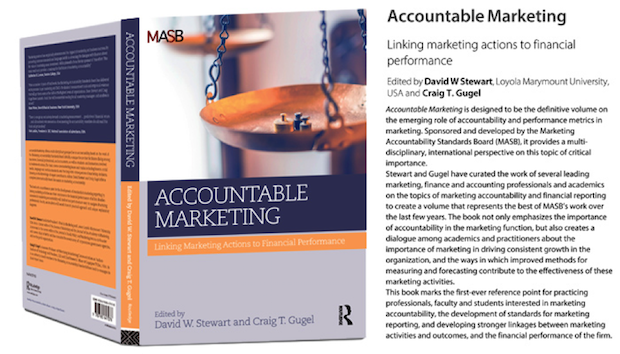
    MASB, the Marketing Accountability Standards Board recently announced the publication of its newest book, Accountable Marketing: Linking Marketing Actions to Financial Performance (Routledge 2016).

    The book sets the stage for new working relations between Finance and Marketing and relates how fundamental change was initiated in the business community through collaboration across industry lines. Topics include marketing science and governance, brand preference, brand valuation, the long-term effects of advertising, social media and the Marketing/Finance interface.

    Jim Gregory, Tenet Partners Chairman, serves as an Advisory Council member to MASB and authored the chapter: Measuring the Value of Corporate Brands. We recently sat down with him to discuss the challenges of measuring the corporate brand as an intangible asset, and more importantly, how marketers can better understand and leverage the value of their brands on an ongoing basis.

    In the chapter you authored, you discuss how corporate brands are business assets, which can – and should be managed just like any other business asset. Yet, the CFO and the accounting world have been slow to adopt reporting methods that recognize brands as valuable assets. Why?

    According to Generally Accepted Accounting Principles (GAAP) internally grown intangible assets such as brands cannot be reported on the balance sheet, however, the dramatic growth of intangibles leaves a huge hole of unaccountable value. This creates a quandary for investors who are left to wonder whether brand-building activities such as marketing are working or whether they are a complete waste of money by the company making the investment. It also causes problems for the internal management of companies because the CFO is unlikely to support marketing budgets if there is no apparent value being created. It is a dichotomy that should have been solved decades ago, but it is priority number one for organizations like MASB.

    How does a corporate brand create value for consumers and investors in ways that are different from individual product brands?

    Product branding is when you are trying to reach one consumer with a message that will motivate them to purchase your products or services. Corporate branding is managing the company’s brand to create enterprise capital and future cash flows. Both contribute value to the company and can be measured and managed to evaluate their performance.

    What’s the first step a company should take to determine its brand value?

    Benchmark tracking how knowledgeable people feel about your brand on a consistent basis will reveal many important insights into how your brand is competing against peers. Data gathering will lead to crafting models for valuing the brand. We benchmark track 1000 major companies across 50 industries so if your company is sizeable there is a good chance they are included in our study. Our approach is fundamentally different from discounted cash flow models that use subjective guesses about the role of the brand.

    The purpose of building a corporate or product brand is to gain and sustain competitive advantage and ensuring customers have a positive experience with you company or product is crucial. What are the key ingredients of creating and managing an exceptional customer experience program?

    Consistency. Consistency in what you say and do. Consistency in your company’s vision and mission. Consistency in your business and manufacturing process. And, always consistency in your culture and how you treat people.

    MASB is an independent forum that works to build greater accountability standards tied to marketing and financial performance. What is your role at the organization?

    I am on the Improving Financial Reporting committee of MASB. In that role I’m continuously trying to communicate with the financial community about the difficult bind that marketers face when the brand value should be accounted for in some manner – pharmaceutical companies account for drugs in the pipeline by listing R&D in the MD&A notes of annual reports, likewise petroleum companies list proven reserves in the MD&A notes. Why not put the corporate and product brand value in the MD&A notes? It would change everything without having to change GAAP standards.

    Accountable Marketing: Linking Marketing Actions to Financial Performance is available for purchase from Routledge. Order your copy today.

    SEE ALSOJim Gregory Talks Powerhouse: The Secret of Corporate Branding on School for Startups Radio

  • Sprint – 1% Less Reliable, But So What?

    I watched one of the most recent TV ads for Sprint the other day and something seemed a little off. All right, the fact that Paul, the “can you hear me now?” guy from Verizon was pitching Sprint was odd, but that’s not it. It was the message he was carrying.

    He started off by saying, “Hey, it’s 2016 and every cellular network is great.” Really? If you say so…

    He continues to explain that they are all so good that now Sprint’s reliability is within one percent of Verizon. Kind of indicating, “We’re about as good as we’re going to get, deal with it”. He then goes on to explain the difference in price and how Sprint is half the price of other carriers like Verizon, AT&T and T-Mobile. The commercial then hits a high note with the tagline “Don’t let a one percent difference cost you twice as much”.

    That’s all well and good, but it left me thinking, “If a one percent difference isn’t a big deal, why not be one or even two percent better”. I guess at the end of the day, a giant telecom company telling me that they don’t have the best network but it’s not a big deal, kind of falls flat. Does this speak to reduced expectations across our society in general? Perhaps. Actually, I think with social media as an easy way of communicating brand performance over a broad population, expectations are higher than ever. Social media can either make or break a brand. To me, Sprint is taking a huge risk with this new messaging strategy.

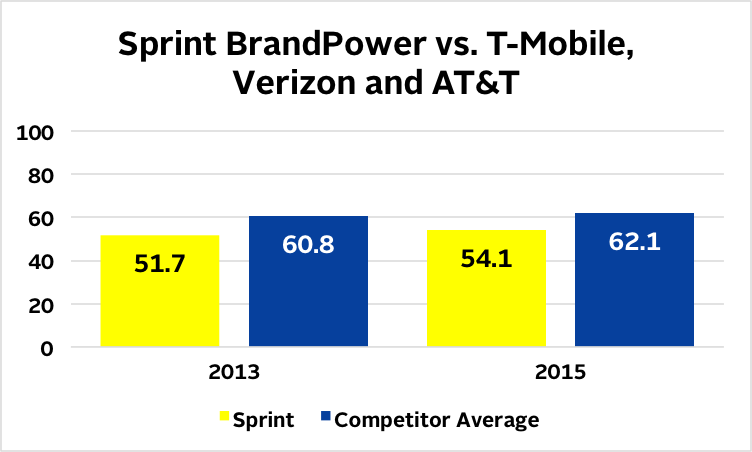
    So, this leads to the question of just how Sprint’s brand compares to the competitors that it names in its ad. What would lead them to use this tactic in their messaging? I examined Sprint’s BrandPower score, which is a measure of a brand’s Familiarity and Favorability (as measured by Overall Reputation, Perception of Management and Investment Potential) produced from interviews conducted by Tenet Partners. Our system measures nearly 1,000 brands across more than 50 industries and serves as a way to determine the strength and vitality of brands. BrandPower is measured on a 100-point scale and can be used as a means to compare one brand to another or a group of brands, or as a historical measure of the brand’s trend.

    Sure enough, Sprint’s brand ranked the lowest across all four carriers mentioned in the ad. Given the weaker brand stature in comparison to competitors, does it really make sense for their communication to focus on them not having the most reliable network, too? I understand that they are trying to communicate a pricing message in a very complicated and crowed marketplace, but for me the message that came across was, “We’re one percent worse than the competition, and we really don’t care”.

    If I worked for Sprint, I’d be very concerned as the trailing brand that the message received will be:

    1. We acknowledge having a less reliable network;
    2. It’s only one percent less reliable, which we think isn’t a big deal;
    3. We are not willing to go the extra mile to close the one percent reliability gap.

    To me, this is an example that illustrates the importance of carefully crafting and managing your brand message. It will be interesting to watch how Sprint’s BrandPower will change over time (sneak preview, its BrandPower is down a smidge in the 1Q 2016 data). It will be interesting to examine if it will have an impact, positive or negative, and which elements of the brand will be most impacted by the messaging.

    If you’d like to learn more about BrandPower and what it might look like in other industries, please look for our upcoming Top 100 Most Powerful Brands report or check out the CoreBrand Analytics section of our website.

  • The Nintendo Brand – Pokémon Go, Go, Going

    Apparently I’m middle aged. I don’t feel like it. I don’t think I look it. But when I make cultural references, those around me often look at me like I’m from another planet. Most recently I’ve been asked the following, “Billy Joel recorded an album in Russia?” “What are Stan Smiths?” And perhaps the most painful, “Fame is like High School Musical?”

    So when companies reinvigorate the brands of my youth, I get excited. And apparently, I’m not the only one. Enter Pokémon Go. Admittedly I had just graduated college when Nintendo released the original game (okay, maybe I am middle aged) in 1995, but the reminiscence of the Nintendo Game Boy, the platform for which Pokémon was first developed, takes me back. And it is this appeal I’m certain the company was counting on the help reinvigorate the brand with its historical audience.

    And to help reinforce the brand with a broader, younger audience, Nintendo smartly looked toward collaboration with game developer, Niantic. A Google-spinoff, Niantic had been known for its augmented reality capabilities. By integrating the Nintendo digital characters with a real-world view that uses our phone’s location tracking and camera capabilities, Nintendo has managed to extend the success of Pokémon into a second decade with Pokémon Go.

    Impact on brand

    With a regular spot on Tenet’s Top 100 Most Powerful Brands – this year at number 94 – there are three factors that portend a jump in Nintendo’s spot on the Top 100 list next year. Keep in mind, the company’s BrandPower score is determined by its Familiarity and Favorability.

    From a Familiarity perspective, there have been reports that in two weeks Pokémon Go has more players than Tinder and possibly even Twitter have users, expanding the base of those familiar with both Pokémon and Nintendo exponentially.

    From a Favorability perspective, Nintendo has seen consistently rising Overall Reputation scores over the last five years with more than a 13% aggregate increase. I’d venture that Pokémon Go’s success will only contribute to that steady increase in Overall Reputation.

    And from a financial perspective, Nintendo’s stock has increased more than 50% in the United States as of July 15, adding around $12 billion to the company’s market capitalization. The gaming company that was previously chasing the Sony Playstation and Microsoft Xbox has now established an entirely new category and positioned the organization as the brand to beat. If Nintendo can maintain the increased stock price and convert analysts, its Investment Potential –a key piece of Favorability – will remain quite positive.

    In the meantime, seeing the success Nintendo has had over the last few weeks, it seems wise to break down its two primary strategies to determine if Nintendo’s success can be sustained and how it may be replicable for other brands.

    Cultural renaissance

    Clearly the world was ready for a virtual reality Pokémon experience. Can Nintendo bring back its other beloved games with a similar approach or is this a one-hit-wonder? Do we want to see Donkey Kong climbing real construction sites or Luigi and Mario collecting coins, bricks and yellow super mushrooms while walking down 53rd Street? I don’t see why not, but game quality, pacing of releases, varying the approach and breaking down the walls of what is possible must continue. Other brands have certainly succeeded by looking backward to continue moving forward.

    Take for example Columbia Pictures; the Sony Pictures distribution house has become known for remaking retro films and television shows originally popular with my generation: The Smurfs, Karate Kid, 21 Jump Street, and most recently, Ghostbusters. Most of the adapted films have proven consistent revenue generators with The Smurfs and 21 Jump Street spawning ongoing series. The appeal lies with both the original audience, as well as the children of those now parents.

    Adidas is also thriving by appealing to its heritage. The company’s first quarter sales are up 31%, its stock is performing at a rate of +31.54%YTD and ten equities research analysts have given it a “buy” rating. Having recently purchased a pair of the same Stan Smith’s I had in high school, I can confirm that the renaissance of adidas’ vintage styles is alive and well. Take your pick between Stan Smiths, slides, Gazelles or Superstars. All four styles are on feet old and young, in cities and in suburbs. adidas is the coolest brand in sports and on the streets right now. Understanding and leveraging its heritage is a big part of that success.

    And consider one of the big movers on this year’s Top 100 Most Powerful Brands list, Whirlpool. Maytag is a Whirlpool brand. In 1967 the Maytag Repairman was introduced as the “loneliest man in town” because the appliances never broke. In 2014, Whirlpool reinvigorated and reintroduced the Maytag Man as the star of a new campaign that not only appears on television, but also includes a broad-scale digital component. With more than 50-years of awareness in the character, who stands for dependability and is highly associated with the brand, Whirlpool has found a way to leverage its familiar heritage to differentiate in an industry that is known for a war of features. And according to its steady rise up the Top 100 ranking, it’s feasible that looking backward to move forward has been a successful strategy for Whirlpool.

    Collaboration

    Nintendo has a history of collaboration. The Pokémon Company is a joint investment by Nintendo and two other companies, Game Freak and Creatures. Pokémon Go was developed in collaboration with Niantic, a spin-off from Google in which Nintendo also made an investment. But the net out remains, Nintendo owns the brand rights to Pokémon. With those rights, the organization saw a way to extend the life of the brand to new audiences and through new mediums. In essence, Nintendo understood its core strengths and looked to other organizations to help augment its strengths. Collaborative innovation has proven a successful model.

    Looking again to adidas, that company has done the same. By partnering with Palace Skateboards, fashion designer Yohji Yamamoto, R&B icons Kanye West and Pharrell, adidas has extended its brand into untapped vertical markets with valuable, long-term partnerships. In the case of adidas, such partnerships have also established a halo effect of “coolness” that is extending the brand to new markets with new potential buyers. For adidas, collaboration is less about innovation and more about reputation. However, we can project that both companies will see an impact on their bottom-line performance.

    Lastly, looking at this year’s Top 100 Most Powerful Brands list, Google seems like the obvious collaboration story. With a five-point rise into the top-ten, Google epitomizes the partnership strategy. Look at the healthcare space alone. Whether through Google Lifesciences or Calico, the company has formed partnerships with major pharma players, including AbbieVie, Novartis, Sanofi and Biogen, as well as with key institutions like Duke and Stanford medical schools, and consumer brands like ancestry.com. While the partnerships are primarily intended to help find big answers, like cures for diabetes, cancer and even death – the overall Google brand is skyrocketing. Through a strategic reorganization and focused partnerships, Google, like Nintendo, is driving future brand innovation.

  • The Changing Face of the Banking World

    Morgan Stanley The Steady Riser

    It’s 2008; I’m living in Canary Wharf, London’s version of Wall Street. One morning, on my way to work, I walked past Lehman Brothers. On the streets I saw men standing, boxes in hand, people turning, staring. What had they done? It must be bad; we’d never seen the bankers look helpless before. The usual image of the financiers spilling out of the bars as the sun begins to set over the imposing buildings; beers in hand, raucous laughter and bravado seeping into every spare patch of pavement, was gone. Perhaps it was a trade that went wrong or a harassment case that bit back. I kept walking and by the time I reached the Tube, my curious thoughts had dissipated. ‘It’s likely nothing’ I thought… Little did I know that the world had changed forever.

    The crisis

    The financial crisis hit causing recessions in countries the world over. However, after the initial shock and falter and the record-breaking bailouts, the dust settled and order resumed. Unfortunately, the bankers were skating on a much thinner sheet of ice than before. And the finance world knew it. Something had to change. The banks had to figure out how to regain the trust of the public.

    Changing perceptions

    Today, I call Manhattan home. Having spent many years working in London’s finance capital, I feel I at least have some insight into what life must have been like on Wall Street pre-2008. The same brash confidence of top dollar earners; the ability to hold more liquor than one should be able; the late nights; early mornings; calls at 3 am because somewhere in the world someone wanted to make some money. But here in the US much like in London, due to legislation, government initiatives, advertising campaigns and more, the mood is now different. The ‘Big Banks’ have changed public perception, and they’re getting stronger each day.

    Time Magazine tells us, “The financial crisis and its aftermath have dramatically changed investor perceptions, particularly with respect to the soundness of our financial system. In response, big financial firms are changing, but few firms have changed more than Morgan Stanley.”

    Measuring impact

    Morgan Stanley, like most financial institutions, got negative press following the 2008 Crash, and it’s taken many initiatives to slowly improve perceptions of their brand. And there’s no better way to measure that improvement than by looking at the strength of their corporate brand, or as we call it – “BrandPower.”

    BrandPower, as identified in Tenet Partners’ annual Top 100 Most Powerful Brands Report, is a measure of brand strength through two key metrics, familiarity and favorability. The index measures factors such as the perception of an organization’s management, the perceived investment potential of their business, and the familiarity of their brand to the general public.

    Like other financial institutions featured in this year’s Top 100, such as Bank of America, Wells Fargo, and Capital One, which have all seen an increase in their BrandPower this year, Morgan Stanley is on the rise. Their multi-faceted approach to changing perceptions has resulted is a consistent upturn in the power of their brand.

    Moving the brand needle

    Since 2011, Morgan Stanley’s BrandPower has jumped up 37 places to the 58th most powerful brand in America according to Tenet Partners’ data. This hasn’t happened overnight. The bank had to concentrate its efforts on giving the public a view into the real people and real activities of their institution.

    An alternative path

    Morgan Stanley’s CEO, James Gorman, who unlike most previous heads of the bank, does not have a background in investment banking, has worked to change the bank’s brand. It has changed its course not, as Time Magazine tells us, completely away from its investment banking roots, but more towards a brokerage model advising clients which stocks and shares to buy and sell, as opposed to investment banking. The difference in approach has made wide impacts on the perception of Morgan Stanley, contributing to it being seen as more of a trusted advisor than a grasping moneymaker.

    Marketing to new perceptions

    To support their new path, according to Advertising Age, Lisa Manganello, Head of integrated brand marketing at Morgan Stanley says “their marketing efforts have focused on highlighting the firm’s “real human” benefits.” And Skyword reiterates with, “a new content-heavy campaign tells the story of Morgan Stanley’s brand in a different way—by presenting the company as a driver of positive human change around the world.”

    Not only have Morgan Stanley’s marketing efforts been revamped, but to support their changing business model, their internal performance management process is also getting a makeover.

    Changing the face of performance

    Morgan Stanley is changing its employee performance management style, dispelling of the traditional annual appraisal process and adopting a fresher approach.

    As Larry Oakner, Senior Partner in Employee Engagement at Tenet Partners says, “how [employees] demonstrate their brand through their behaviour has a huge impact on the successful integration of the brand into the organization.”

    An article in the New York Times about Morgan Stanley’s new approach states, “The aim is to give more direct feedback and better steer staff members toward areas of improvement.” Employees will be evaluated on their overall contributions to the firm, not only the money they bring in.

    On the rise

    Elevating the power of a brand is a multi-layered initiative that encompasses all business activities, and Morgan Stanley is a bank that shows it knows how to do it. It’s been a long road for them since the 2008 financial crisis, and, like any organization, they’ve had their ups and downs. But with their varied efforts and a BrandPower ranking that’s consistently rising, it seems that their battle-tested CEO, James Gorman, is doing something right to reinvent the image for their institution.