Category: Take 5

Five quick tips to help you better manage your brand.

  • The role of environmentalism in modern consumer brands

    Patagonia is a brand that is so eco-friendly their CEO would rather teach you how to repair your fleece than sell you a new one. As a certified B Corp, their brand promise is built on environmental activism, placing business philanthropy at least on par with profits. At The North Face, on the other hand, they believe “the best way to be sustainable is to make product[s] that would last a lifetime.” As a result, their brand promise is focused on innovation and durability.

    We view a brand promise as the core idea that unifies your brand. It is a distillation of your brand positioning, which is in turn built on a foundation of positioning attributes. These attributes range from foundational – meaning you must have them simply to be in your industry – to differentiating – meaning they are distinctive and set you apart from your competition. These elements, collectively your “brand platform”, are internal but drive the outward expression of your brand – including in marketing communications.

    This means that while we may not be able to see the brand platforms for Patagonia and The North Face, we can infer certain priorities based on their external communications including websites, advertising and press interviews, among other things. For both brands, environmentalism / sustainability is present in their communications, but it plays a very different role for each.

    For The North Face, environmentalism seems to be a foundational attribute. Sustainability is important to the brand – for example, “Protect” is one of their three core tenets of corporate responsibility, alongside “Product” and “Empower.” However, with so many other outdoor and sportswear companies focusing on their environmental credentials, The North Face feels they need something more. For them, that “something more” is making the product the hero – but sustainability still gets its play, with the idea of creating less waste implicit in their claims about durability.

    For Patagonia, on the other hand, their environmental mission is their prime differentiating attribute. In the words of the founder’s nephew, “There was a strong sense from the beginning of wanting to protect the wild places.” Their “Provisions” line of sustainable food, a focus on protecting their supply chain and “Patagonia Action Works” – a network to connect individuals with grassroots environmental activists – are just some of the ways they demonstrate their dedication to corporate stewardship.

    Patagonia is not alone in this trend. It is becoming increasingly common to hear brands talking about their “purpose,” beyond delivering shareholder value – at Cannes Lion 2019 the topic was discussed extensively by top brands including Unilever and P&G. The key here is not to view it as an either/or proposition –brands are seeing that authentically committing to a higher purpose can actually increase revenue from socially-minded consumers who want to reward like-minded corporations. But that word, “authentically” is pivotal – if brands are talking the talk but not walking the walk consumers will notice.

    Grappling with the role of environmentalism is not a new struggle for brands, and particularly consumer brands that generate “stuff.” As far back as 1987 the U.N. published a report opining on how corporations could reconcile sustainability and development. The issue has certainly gained more attention in modern times with Millennial – and now Gen Z – influencers increasingly holding brands accountable for their operations. Environmental, Social and Governance (ESG) is becoming a byword from boardrooms to trading desks, and instances of corporations behaving badly can always be counted on to blow up social media.

    What all this tells us is, in today’s culture no modern consumer brand can afford to ignore its environmental footprint – even those brands whose “purpose” lies outside sustainability. However, it is important that you approach the topic in a way that is authentic to your brand and credible to stakeholders, both internal and external. As the successes of both Patagonia and The North Face clearly demonstrate, there is no one right way to incorporate environmental sustainability into a brand platform.

    About the author

    Laura Scharf is an experienced strategist who has played an integral part in (re)branding and activating dozens of brands. From leading discovery—including IDIs and competitive audits—to crafting authentic, differentiating positions to defining architecture and messaging, she brings creative problem-solving and grace under pressure to all her projects. Current clients include Edwards Lifesciences, Gore, Mastercard, ACA Compliance Group, Hartford Steam Boilers and Trinity, among others.

    Before joining Tenet, Laura was a strategic account director at Starfish and a brand strategist at TippingGardner. Her expertise spans B2B, B2C, and non-profit with a particular focus in professional services. She has an MBA from the Leonard N. Stern School of Business at New York University.

  • S&P 500 companies gain outsized returns by investing in their brand

    In a recent study published by The Society for Competitiveness, 119 consumer facing corporate brands and their revenue growth rates were studied. This study was unique in that product branding contribution to revenue growth is extensively examined but corporate brand contribution to revenue is far less analyzed.

    The data examined was for the period from 2011 to 2016 and includes Tenet Partner’s CoreBrand Index® which provides BrandPower (a survey measure of Familiarity and Favorability with a corporate brand), fundamental financial data, and paid media from Kantar Media Intelligence.

    This research drew on from our chairman James Gregory, Ph.D. and Jack Weichmann’s definition of the corporate brand – “that is the public’s perception of a company – the preconceived ideas and prejudices that have formed in the minds of customers” (1991, pg.2).

    The CoreBrand Index (CBI) was developed to address the lack of quantitative data available on corporate brands. For over two decades it has been the basis of models that measure how the brand contributes to market cap and brand valuation.

    The CBI is a telephone interview conducted among an audience of impartial observers. Respondents are business leaders who are also affluent consumers. They are Vice President (VP), Director and Manager level executives in the top 20% of U.S. businesses, based on revenue. Respondents rate their Familiarity with a list of 40 companies. Those that indicate that they know more than just the name of the company are then asked to rate Favorability on three attributes: Overall Reputation, Perception of Management, and Investment Potential. These measures are then combined to create BrandPower, a single measure that conveys the corporate brand’s size and quality among respondents. The measures are reported on a 100-point scale. Each company is rated by 400 respondents per year. Approximately 1,000 companies are tracked, many dating as far back as 1990.

    Figure 1 below highlights the analytical process employed by the authors to examine how corporate brand can contribute to revenue growth.

    The first step was a correlation matrix that examined BrandPower growth in different time periods compared to revenue growth. 1-, 3-, and 5-year changes were examined. The results were not as encouraging as we expected. Ultimately, it was concluded that the level of BrandPower may be impacting the relationship. Larger brands were maintaining, not growing. Smaller brands were seeking critical mass. However, mid-level brands had both mass and room to grow. This was then proven in our quintile analysis, where we saw the brands in the middle tier had the highest rates of growth for both BrandPower and revenue.

    The tiers refer to the company’s level of BrandPower. Tier 1 is the strongest, followed by Tier 2 and so on. Examples of companies in Tiers 1, 2 and 3 are:

    • Tier 1 – Coca-Cola & McDonald’s
    • Tier 2 – Tyson Foods & Old Navy
    • Tier 3 – Pet Smart & Papa John’s

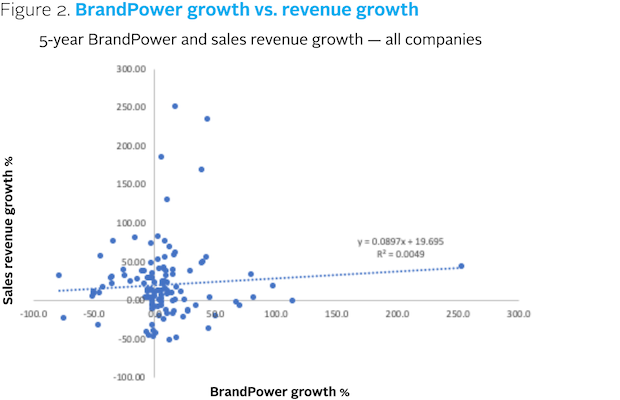
    Figure 2 below shows an overall regression analysis of BrandPower growth rate and sales revenue growth rate for all 119 companies.

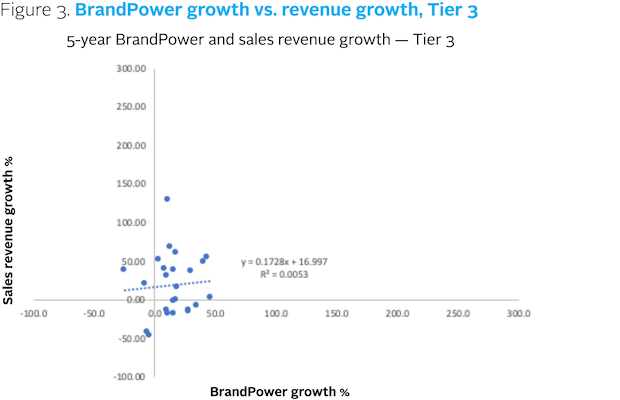
    Figure 3 below identifies the same analysis, but with only the middle tier, tier 3, companies. As can be seen by the regression conducted, the growth coefficient is nearly twice for tier three than it is for the entire group, 0.1728 vs. 0.0897. This indicates a higher rate of revenue return for BrandPower growth among the tier 3 companies than for the broader group of competitors. This result informs us that companies in the middle tier have tremendous incentive to improve their BrandPower.

    Further analysis of paid media spend and BrandPower demonstrated that as paid media increased BrandPower increased. An analysis of brand valuation showed that for an incremental paid media investment of $1 million, a $2 million increase in brand valuation could be expected. This 2:1 return on investment is a significant argument in favor of investing in the corporate brand.

    References

    Koch, C., Puckey, B., Williams, V. (2019). Empirical Findings: The Corporate Brand, Competition Forum, American Society for Competitiveness, Vol. 17, Number 1, 2019, (1-12).

    Gregory, J.R., & Wiechmann, J.G. (2001). Marketing Corporate Image: The Company as Your Number One Product. Lincolnwood, Illinois: NTC Publishing Group.

  • Now, more than ever, intention, message and tone matter

    In times of crisis, we are reminded of the fine line between offering support and capitalizing on tragedy. With the current global pandemic bringing unprecedented strife and disruption, it is more important than ever that brands maintain lines of communication—but do so in an appropriately human way. The current crisis hopefully has a relatively limited window, but the impact of how brands communicate with their audiences during the crisis can have long-term effects, both positive and negative.

    It’s about considering the frame of mind of the person receiving the information and asking yourself not, “do I want to convey this information?” But rather, “do they need to hear this information? Am I being relevant to them in this moment?” For brands, that means recognizing our shared reality, and containing your message to assurances that you are still operating, while taking all safety precautions, and therefore are still there for clients in these trying times. It may also mean reaching beyond your typical talking points, adapting your message, product or service to help solve the current need, i.e. relevance. Your tone should be compassionate and authentic, and your message focused. Note the difference in these two emails:

    (to existing customers) As we all work to navigate the ongoing effects of COVID-19, I’d like to let you know how we here at [company] are responding to the challenge and what it means for you.

    We’re very well positioned to adapt to the current crisis, thanks to a long-held philosophy of workplace flexibility and employee ownership. The team members you work with every day are equipped with technology and collaboration tools that allow them to stay engaged wherever they are.

    versus:

    (to new contact) I hope that you and your loved ones are healthy and managing through the quarantine. Things are quite interesting on my end, trying to work from home and home school two middle schoolers. The wine is very well stocked. ?

    While the world is a bit strange right now, [Company]’s top priority remains our clients. Therefore, I’m passing along this Coronavirus Insights Kit our research team has put together over the past couple of weeks.

    The first is reassuring, the second off-putting. The first authentic, the second forced.

    Communications are a key part of how we build brand presence in the mind of our clients. Brands have personalities, just like people, and messaging and tone should be grounded in and reflective of those personalities. The communications we put out now will contribute to lasting impressions beyond the current climate: a message that reads as tone-deaf or opportunistic now can undercut a carefully established strategy built around more positive brand personality attributes.

    Now is a time to be generous and considerate with each other. It is a time to demonstrate the best your brand can stand for.

  • Five ideas to help brands make an impact

    The world has dealt with a lot in the first months of 2020. Events are changing how we live, think, do business, and how we’ll move forward. Fundamentally what we have are two very different energies tearing at our norms – powers of nature thrust upon us and long-standing societal choices coming home to roost. Both are forcing brands to evolve. But how should that happen?

    As an agency that believes in the power of Brand to create positive change, we’re intensely curious about how businesses and organizations are responding. In March and April as coronavirus brought confusion and fear, we looked on, a little underwhelmed as brands adopted safe playbooks offering eerily similar messages with somber music, empty highways and refrains of “we’re all in this together.” But with time, many began to translate good wishes and hopes into action by helping local communities, finding ways to protect workers’ health and income, and start serving their customers again.

    Today, coronavirus remains an ever-present danger, and brands are discovering the potential positive impact of a coordinated Black Lives Matter movement. Ultimately what we hope to see brands do, and what we advise clients to aim for, is commit to more than superficial change. Right now, we want to see brands take a leadership role by promoting discourse on systemic racism proactively, not only when their actions, communications or logo is called into question, or because other brands have done so.

    Why though? Why do brands have a role to play in advancing social justice? We believe that as brands have evolved, creating deeper connections with consumers, having a personable voice in social media, asking us to consider them more human, they have responsibility to be more human and help move the rest of us humans forward.

    As always, the best examples of brands in action are those making decisions through their brand lens. They ask, “applying our core values to the present moment, what are we capable of beyond our product or service?” “How do we align with our customers’, executives’ and employees’ stance on the issues?” “In our lane, what slack can we pick up? What can we do, functionally and emotionally, better than anyone else?”

    As your brand weighs short- and long-term strategies, here are five critical actions that can guide you through the rest of this year and beyond:

    1. Aim for substance
    The easiest, quickest changes to make are at the surface. But we don’t advise stopping there because superficial tweaks in your brand communications or token actions don’t have the power to bring people along to your point of view. That’s hard work, true, but it can reap the greatest rewards in terms of making progress. NBCUniversal committed to a workforce made up of 50 percent people of color, 50 percent women. That’s impressive. Substantive action doesn’t have to be changes to workforce, logo or name (more below) but can go to the root of the problem. Netflix pledged to shift up to $100 million to banks and initiatives that serve Black communities. The potential impact is massive, helping make loans available to people who, historically, haven’t had access to investment capital. That’s a substantive change.

    2. Be true to you
    When looking for rules to play by, start with your brand. That’s why it was created, to establish traits and values that can guide your brands through whatever comes your way. If you don’t have a thoroughly thought out brand strategy that accounts for unforeseen scenarios, now is the perfect time to set down how you believe you should act during crisis or societal unrest. No brand could have planned for current events prescriptively, but strategically you can create a proactive brand that grows and provides a strong foundation from which to lead when the unexpected arrives. Because it will. We recommend your planning going far beyond reactive crisis communication, adopting aspirational thinking, and taking a hard look at the changes you need to make to live your values. Ben & Jerry’s progressive brand values emphasize deep respect for people inside and outside the company. While their reaction to George Floyd’s murder was extraordinary and unexpected in its detailed call for police and legislative reform, it was 100% authentic to what the brand stands for.

    3. Re-align brand values with customers’ and employees’
    Even brands led by charismatic frontrunners cease to exist without customers who share their passion and employees who bring the brand to life. That’s why it’s important to have a pulse on your customers’ POV and act on it. This isn’t a question of aligning with customers whether “they want change” vs. “they are cool with the status quo.” If your customers come down on the side of an issue that goes against your best moral judgment, it’s your opportunity as a public-facing entity to change hearts and minds. NASCAR recently angered some fans by banning displays of the confederate flag. While it may have been a calculated effort to gain brand awareness and expand its audience, we applaud it equally as an effort to bring a different perspective forward.

    The most effective organizations are those in which the leaders and employees share the same beliefs, this is how trust is created and it applies to day-to-day business, as well as social issues. This moment is an amazing opportunity share corporate beliefs and get people on the same page.

    4. Lead society forward
    Brands don’t have to be as outspoken as Ben & Jerry’s to inspire progress. For decades, Land O’ Lakes, Aunt Jemima, Uncle Bens and others felt pressure to change racially offensive logos and names. 2020 is their time to act, hopefully bringing awareness to institutionalized prejudice. After Quaker Oats decided to rebrand Aunt Jemima by removing her image from packaging, NPR spoke to the niece of one of the women who served as the inspiration for the illustration, Lillian Richard. In the piece, she shared concerns that her aunt’s contribution to the brand will be erased, forgotten.

    But what if Quaker Oats had taken it on themselves to talk to Richard’s family, and those of other brand ambassadors? The niece made a strong point – Richard’s was extremely proud of her role as Aunt Jemima at a time when few women worked, and even fewer black women could have had that level of visibility. Was it the right kind of visibility? Richard’s niece says she backs the logo change, but wishes Quaker Oats had started a conversation that could have celebrated the contribution women of color made to the brand. The situation is still evolving, and after consideration, we’d advise the brand to pick up the conversation where NPR left off.

    Also evolving is the future of the Cleveland Indians and Washington Redskins. As the franchises take action (the Redskins have announced an interim name, the Washington Football Team, while the renaming project continues), it’s an opportunity to promote new beginnings, renewed energy and cultural relevance. The teams can claim not just being on the right side of history, but being part of this moment in our history by recognizing and building awareness for the Native American groups that have long been their symbols. How many organizations wish they could generate this much conversation around their brand, or be as relevant to the conversation?

    While the changes to Aunt Jemima, the Washington Football Team and others are significant, product rebrands and even team name changes occur regularly, and consumers and fans still show up. Their success will rest on the ability to find an authentic voice that speaks to core values (new or existing) and re-build trust with consumers.

    5. Increase authenticity and transparency
    Today is also the perfect time for brands to come clean and publicly right wrongs they’ve made in the past. There are many examples to pick from, but the NFL is an easy one. In early June, the San Francisco 49ers told us that Black Lives Matter to them which is a step in the right direction. But there’s more that we’d recommend the brand do, given its past with Colin Kaepernick who they planned to release after he famously put police brutality awareness on the 50-yard line.

    At the same time, the league itself apologized for not doing enough to hear players’ concerns on racial inequality. They’re moving the ball up the field, but critics say they’re not quite there yet. What could win them over? Trust may be forward looking, but it’s based on the past. The NFL will have to loudly proclaim its renewed values and live them every day. As the adage goes, actions speak louder than words.

    Our advice on authenticity applies across the board for organizations’ well-intentioned reactions as well – they have to truly believe in something and commit for the long-haul. For instance, it’s encouraging to see company’s make Juneteenth a paid holiday this year, but if it’s not based on larger plan for promoting equality, awareness and education, the meaning risks getting lost.

    People want to know what your brand stands for now Today, brands have made great progress becoming more human, allowing consumers a connection beyond products and services. What this means though is that people are more aware of how an organization’s actions jibe with stated values, and are not afraid to call out or cancel brands. This should not strike fear into brand managers, but demonstrate the opportunity to deepen affinity.

  • Increase the impact of your messaging

    Messaging defines the point we’re trying to get across, whether it’s an individual engaged in casual conversation, a political leader making a speech, or a company telegraphing the value of its brand. But often, messaging is too complicated and overblown.

    To be useful, messages need to be internalized by those who deliver them. Not rote memorization, but a deep-seated understanding of what needs to be communicated.

    Take these five principles to heart when crafting your messages to reach your audiences more effectively:

    1. Messages are ideas, not copy.

    This is where most messaging falls down. It’s a matter of understanding what a message actually is. The message isn’t the words you use. It is the “sticky” thought you want your audience to remember ten minutes after you’ve walked out of the room.

    More importantly, the message should never appear in copy! In the 1992 Presidential primaries, then-candidate George Bush inadvertently read aloud a note inserted into his speech by an aide: “Message: I care.” That aide understood the true nature of messaging: It’s the thought that counts. The language you use to deliver that thought is something else entirely.

    2. Keep it simple.

    The simpler the message, the more memorable it will be – and therefore, the more useful for you and meaningful for your audience. No one will remember a long paragraph loaded with detail or a complex sentence. Everyone can remember a straightforward idea, expressed simply.

    A sales associate should not have to refer to a written guide to remember what should be communicated. Use whatever words are necessary to deliver the thought but keep the message itself as simple as possible. Secondary messaging can be created to support and add dimension but should never get in the way of communicating the pure, clear idea of the main message.

    3. Keep it streamlined.

    How many messages could you remember if you had to? Less is definitely more. Your set of main messages should encompass what you need to communicate but be flexible enough to carry multiple meanings depending on the language used to communicate the thought.

    For example, a message like “We make a meaningful difference in people’s lives” might come through in copy about products, social responsibility, client relationships or the workplace environment. Different words, different audiences, different uses, but the same core message.

    4. Make it relevant.

    The only messages that will be remembered are the ones that the recipient finds meaningful and compelling. Often, we see companies so wrapped up in their internal structure and culture that they lose sight of the fact that to an outside audience, none of that matters much. Or the message may fall back on meaningless platitudes.

    Craft credible messages that those on the receiving end can relate to, with just enough detail to make what you communicate meaningful.

    5. Use it wisely.

    It’s neither necessary nor wise to say everything, every time. It is, however, necessary to send the message repeatedly and in different ways to make sure it sticks.

    Choose the proof points and supporting messages you use to make your point in a way that resonates with your audience. Also, be selective in which messages you send at any given time: If you’re lucky, your audience might take away one or two thoughts, so it’s best to focus and stay on-topic. Trying to get six ideas across will only muddy the waters.

  • How to Reshape Collaborative Brainstorming to Mine for Creative Inspiration

    As Design Thinking continues to change how innovation is achieved by many product and service providers worldwide, the traditional tools and techniques for capturing and incorporating the voice of the consumer are in much need of reshaping as well. Conventional focus groups serve their purpose when planned and facilitated well. Likewise, collaborative brainstorming sessions need to be well crafted and executed to take advantage of what participating consumers, clients and creatives do best.
    Our brand of Design Thinking features a tool kit of methodologies including Co-Magination® Sessions that take group collaborative brainstorming to a new and more productive level. Beyond obvious distinctions to many focus group and consumer-centric collaborative sessions (e.g. keeping all participants in the same room(s), and live illustrative capture of seed ideas as output throughout), here are five tips that can make any session more effective, with output that is more prolific and inspiring.

    1. Appreciate that Everyone Is Creative, or Can Be.

    To some extent, everyone can be creative, especially if invited to become part of a creative team as a unique and valued contributor. Introduce consumer participants as the experts in their individual experiences with the category, products or services you are re-imagining together. They will take pride in contributing their expertise, perspective and experience, as no one else can.

    2. Work Together as Creative Peers.

    Beyond the clichéd “there are no bad ideas,” we live by “there are no bad voices,” or at least no more important ones than others. Working shoulder-to-shoulder, likely for the first time, clients, consumers and design innovators become empathic and constructive collaborators when there is no perceived hierarchy in the group. This democratic approach will surprise you by the quality of the insight and inspiration it produces, and the passion it is often voiced with.

    3. Make it Engaging, Make It Interesting, and Make It Fun.

    Participants can all too easily shut down if they feel they are in for two hours of seated Q&A. Get them up, get them thinking, and make sure everyone is comfortable and responsible for contributing. All activities should relate to the session’s area of focus. No frivolous, off-topic chit-chat, “creative squeaky toys,” play-doh or beanbag chairs, unless any of those are relevant to the task at hand. These can be a distraction and a waste of your valuable time together. Through various exercises including role playing, accelerated reenactments, competitive breakouts, mini presentations, among others, get everyone to immerse themselves in the moment, draw from their individual life experiences and check their self-consciousness at the door.

    4. Make Sure You Have the Right Creative Talent.

    We deploy our Design Innovators into the mix to be inspired by the collaborative output. Although consumer and client participants may be creative, insightful and full of great ideas, most are not able to articulate or visualize what a real world feature, attribute or concept might look or feel like. The talent and experience of your creative team is key to translating spoken whim into viable, visible direction, spontaneously, for iterative enhancement and directional validation.

    5. Don’t Be Misled by Personal Favorites.

    And finally, don’t put too much weight on participant selected “favorite ideas.” Do however listen to how they defend their preferred directions to learn what pet peeves and inconveniences they want to solve. In traditional focus groups and even in many collaborative group sessions, clients and facilitators are easily tempted to take consumer input as direction. We prefer to use it as inspiration. There’s a goldmine there, if you know what you’re listening for.

  • How to Beat the Odds and Ensure a More Successful Acquisition

    Unfortunately, mergers aren’t always successful. Some fail because one company overestimates the worth of the other—and overpays. Other times, failure can be linked to a lack of synergy in services, products, resources or markets. But history—and a recent KPMG study reveal that cultural misalignment among other issues put the failure rate of mergers at 83%. And it’s culture that drives employee behavior. Before the merger papers are signed, here are five tips to help you make sure your acquisition will be smoothly integrated into your business.

    1. Assess the cultural gaps

    The acquiring firm should compare and contrasts its own cultural behaviors with the acquired firm to determine what they share and what’s different. Is the management command and control, or more democratic? Is one company staffed with long-tenured employees and the other with Millenials? Performance reviews, employee on-boarding practices, and internal communications are just some of the processes that should be evaluated and compared side-by-side. This will reveal insights where the greatest degree of changes may be required.

    2. Identify the strengths and values of the acquired brand

    Companies with well-defined brands may have strong values built on a legacy of service and production. It’s important to evaluate the strength of the established brand and consider how to keep any valuable and unique equities that characterize their culture.

    3. Create a realistic timeline for the integration process

    Integrating an acquisition into your organization requires a timeline that takes into account the unique cultures of both companies. The initial assessment will tell you the areas to go slow or speed up. Identify key milestones such as a stabilized workforce and when HR platforms are fully incorporated. Play out different scenarios for change before you start the process. The benefits of doing so means you’ll have a smoother period of transition if you know where you’re headed.

    4. Chart the specific areas for cultural and operational transition

    Acquiring a company takes more than just assuming another business. There are operational issues in factories, systems in HR, communication brand standards and employees to consider. Assign teams to manage different areas that can coordinate what needs to be done across organization. Create a cross-functional “merger” team with representatives from both companies to have a “two-way” view of the process.

    5. Build a communication strategy to keep everyone informed

    Change produces anxiety. Lack of information prompts rumor. As a central element of an acquisition process, build a communication strategy that informs and engages all stakeholders from both acquirer and the acquired organization during the transition process. Go beyond Town Hall and occasional newsletters. Consider two-way feedback between both sides of the acquisition through internal online forums and workshops.

  • How to Leverage Technology to Enhance Your Employee Review Process

    More and more, research is showing that the traditional annual review process is clunky, time consuming, and failing to deliver the results employees, managers and organizations need. But, review data is vital for assessing role competencies and for understanding talent development needs. That’s why many HR teams are redefining their employee review processes through new technology. These five tips can help you make the most of technology to enhance your employee review process.

    1. Drive accessibility through technology to enable 360° peer reviews

    When building a brand-aligned employee review process, it’s vital that all employees be able to give and receive feedback to ensure non-biased and fair reviews. However, some employees on the factory floor or working out of an office may not have computer access. An easily accessible, web-app review tool can enable 360-degree feedback from all employees. It can drive engagement and deliver valuable data about how well employees are living your brand.

    2. Align your employee reviews to desired brand-focused behaviors

    When creating a new employee review process, technology can help you to measure brand-focused goals such as brand personality attributes or brand service principles. The key is creating a metric that makes it easy for managers and peers to assess employees against brand behaviors, which are pivotal to keeping the brand promise that you make to your customers.

    3. Keep technology simple to capture valuable data

    An easy-to-use, dynamic interface is key when adopting new technology. If it’s helpful, people will use it. Create a simple, portable tool that allows employees to provide real-time feedback about their peers who are living brand behaviors and you will collect valuable review data. With so much of what employees do in the workplace now online, the ability to record how employees perform is easier than ever. The more data you have, the more you can inform training, development, recognition and hiring needs all aligned to your brand strategy.

    4. Technology is only part of the process

    Peer review technology enlightens the wider review process; it is not the only source of information. The data makes it easy to have frequent and periodic two-way conversations between managers and employees to discuss the performance and development needs of each person.

    5. Technology is just a tool

    Technology doesn’t drive brand engagement; brand engagement drives the use of employee review technology. Technology is a useful tool to collect information for employee reviews and for employees themselves to see their part in the review process. New technology can enhance how employees work, but if it is not aligned to organizational goals, it will be useless. Using data to inform effective development conversations is the key to getting the most from your technology.

  • Create Recruitment Messaging That Will Attract the Right Candidates for Your Brand

    Finding candidates is tough. Finding the right candidates can be even tougher. But, recruiting the best candidates is key for growing your business successfully. Getting the best people in the door means using your organization’s external brand to identify the prospects that can best execute that strategy. To find the right employees for your business, take a more brand-aligned approach to recruitment. These five tips can help you attract the best candidates to your organization:

    1. Create brand consistency across recruitment outlets

    When a candidate searches for a job on your internal recruitment pages, LinkedIn, Career Builder, or Glassdoor, they get an impression of your company and that impression influences whether candidates will apply.

    Many websites offer standard templates that make it easy to adopt their format. Be careful following their templates means you lose an opportunity to create a consistent brand message across all channels. Using your own template gives you better control of the recruitment process to find the best-fit employees for your business. Write your job description headline in the same unique brand voice as all your marketing communications.

    2. Differentiate your company from competitors

    Your brand is how your customers differentiate your product or service from your competitors. Unfortunately, many companies use boilerplate text in a recruitment ad that’s not appealing to applicants. To get the best candidates for your roles, communicate the key differences of your product or service throughout all parts of the recruitment process. Including, when messaging to internal and external candidates, during the complete interview procedure, and when making final offers to candidates.

    3. Use language to entice and engage

    To engage applicants, you need to use engaging language. If applicants feel as though you have invested little time in recruiting them, they are likely to be the kind of people who will invest little time in your company. By describing your company’s mission, vision and values so that people know who you are and what you stand for and by spending time explaining the position in honest terms applicants gain real insight into the open position. This way, you get applicants who are prepared for what’s the job offer and who are passionate about your brand.

    4. Make templates easy to implement by your entire HR team

    Needs change, roles change, and so do your HR employees who create the recruitment ads. Using a template that describes the basic recruitment details aligned to your company’s brand ensures uniformity across the recruitment process. As a result, you will receive a consistent caliber of applicants across your organization.

    5. After recruiting, drive your brand across your HR practices

    Once you have people in the door, it’s easy to think they will settle into your culture because you’ve spent the time to find the right fit. However, if you don’t continue the ‘on brand’ experience, people will quickly feel the recruitment messages they received were misleading and they will not understand how to deliver your brand promise. Drive your brand through onboarding, recognition and reward, and ongoing development to keep employees engaged and aligned to your organizational goals.

  • Educate Employees on Your Brand to Drive Your Business Strategy

    A brand is much more than a name for a company, a product or service. The power of a brand runs much deeper. A brand holds with it an expectation of service, product type, product variety, reliability, fun or loyalty. It should be a total experience, driven by a set of values that are aligned to your business strategy and demonstrated daily by your employees.

    Before you can expect employees to live your brand, they need to understand what makes a brand unique. These five tips can help you to drive your business strategy by educating employees on your brand:

    1. Help employees to understand branding

    Many people don’t understand how branding works; but as consumers, we are all used to branding when we make purchase decisions. Your goal is to move employees from having general knowledge of branding as members of a consumer society through to seeing your brand as an organizational asset. Ultimately, they will learn how their roles as employees can be aligned to their brand.

    2. Drive the importance of brand positioning

    Making your product or service stand out from the competition is paramount if you want to stay in business. Work with your employees to understand what makes your offering different and how they can contribute to that differentiation to help your brand stand out from the crowd. Being successfully differentiated is how to best utilize your blend of employees, products, and culture. Involving employees in defining and shaping your brand also helps to drive employee brand engagement; a key factor in business success.

    3. Explore your brand promise

    How employees interact with your customers and with each other is integral to your business success. Do your employees also live the promises you make to your consumers? Do they fulfill those promises with every consumer interaction and fellow employee? Educating employees about your brand promise helps them to understand what behaviors they need to display to drive that promised experience to your customers.

    Branding isn’t always about big, flashy advertising campaigns. It’s about creating differentiation from your competitors. Every company has a brand. Whether or not you choose to manage your brand, however, can be the difference between success and failure in business.

    4. The right brand education can make or break your brand promise

    Educating employees on the behaviors needed to live your brand promise is one thing, but using education to change behavior requires creativity. Individualizing training through personalizing your brand for employees and preparing trainers with the right tools to make the most impact for all types of learners helps make new behaviors stick. For example, you can train employees by asking them to apply the brand behaviors to realistic scenarios based on everyday work experiences. Starbucks created a major facility and exhibit to physically immerse managers and employees in the brand experience.

    5. Reinforce and instill employee brand behaviors

    Reinforcing desired brand behaviors is fundamental to lasting success of employees living the brand. Give people opportunities to practice and be measured on their ability to use their new skills in the real world. Consider initiatives like peer reviews of brand-aligned behavior. Branded recruitment and onboarding programs can also help embed new behaviors for the longer term.