Category: News

  • Know your customer

    New York, NY (February 27, 2015) – Original article at: Business Observer

    Knowing your customer and managing the purchasing experience is so important that an entire business marketing science has been built around the process. Customer Experience Management, or CEM, is about understanding your customers and the journey they travel to enjoy the products or services you have sold them.

    When you initially think of customers, the “consumer” comes to mind. But the ultimate consumer can be different depending on the complex needs of businesses today.

    Customers come in two basic varieties. One group consists of the customers who generate revenue by purchasing goods and services — these are at the top of the food chain. These revenue customers are essentially the individuals or businesses who purchase from your company.

    The second group is composed of the internal customers who make the selling possible. They include employees, investors, management, vendors, etc., each with a stake in the company’s success.

    When these internal teams pull together, they create a bond with the revenue customer that is the essence of brand loyalty. These bonds are created by a deliberate building of relationships at the smallest element of trust. Wal-Mart’s founder, Sam Walton, described it: “The goal as a company is to have customer service that is not just the best, but legendary.”

    Here are some tips to getting to know your customers and starting the journey to the best customer service.

    Know your customers as well as they know you
    OK, it may be impractical to know each one individually, but you should make every effort to know the basic demographics and motivations of your customers. “Big Data” is everywhere within your company to inform you about your customers’ buying habits. All you need to do is mine and organize the data to get useful and actionable insights into your customers.

    Customers want to know more about your company
    What do you stand for? What do you believe in? What are your hiring practices? How do you treat employees? What nonprofit charities do you support? What are you doing to make your company more sustainable? All of these things matter more now than they did in the past ,and it is helpful to have a written policy that addresses each of your supporting pillars.

    Customers love to be acknowledged
    In the TV show “Cheers” there is a line in the title song, “Where everyone knows your name.” That says everything about how to keep your customers coming back. Train your employees to remember customer names and your loyalty ratings will skyrocket.

    Customers love a thoughtful surprise
    I was recently passing an upscale jewelry store on a crowded sidewalk and asked a young man near the entrance of the store if he could replace batteries in a Swatch Watch. I felt a little embarrassed to even ask since the store carried only upscale watches. The young man said, “Yes, we can do that for you,” and took the watch and came back in a few minutes with a new battery. I asked how much I owed and he said it was a gift from the owner. I then went into the store and spent the next several hours doing my holiday shopping.

    I learned later that the young man was the owner of the store; he was the grandson of the founder, who believed in great customer service. His friendly investment of a few minutes time and a watch battery resulted in a significant ROI and a new customer who would be telling his friends about this great store.

    Know your customers personally
    Take the time to visit with them for a few minutes. Try to understand how their experience with your company and your brands fit into their lives. How far did they travel to make this purchase? How did they hear about you? How long have they been purchasing from you? What role does their experience with your company and products fulfill for them?

    If you can’t do this one-on-one, then consider hiring a professional research firm to better understand your customers. This research can be the source of expanding to new territories and the development of new products and services for your company.

    The bottom line with customer service is that customers want someone who will listen and solve their problem and deliver what they promise. If customers see you as someone who cares about their needs, you will no doubt be rewarded with their business the next time they make a purchase.
  • Introduction to Energy Branding Trends

    New York, NY (February 23, 2015) – Original article at: Levick Energy

    Over the past decade, the energy industry has been impacted by countless significant events. While some were the result of human forces and others were natural occurrences, in all cases they changed the way that the public perceives the companies in charge of extracting, producing, and distributing energy resources.

    During this decade, we’ve seen the largest-ever marine oil spill, the biggest power outage in U.S. history, and questions about nuclear safety post-Fukushima. We’ve seen activists seize control of our energy dialogues and turn the tide of public opinion on promising domestic energy sources. We’ve seen the impact that companies with only tangential intersections to the energy industry can have on the overall perceptions of the industry and its component sectors. And today, we are experiencing a major collapse in the price of oil due to many interrelated factors including the fracking revolution, reduced demand in Asia and Europe due to weakening economies and new efficiency innovations.

    In some cases, these sectors have suffered significant reputational and financial damage by events outside of their control. In collaboration with Tenet Partners, the leading brand measurement and valuation firm, we will dig into these trends and explore the factors that can impact the crude oil and petroleum refining segments of the energy industry. Our goal through this project is to understand the ways in which events can impact the “brand power” and short- and long-time influence of corporations and energy industry sectors. In so doing, we can better understand how industry can prepare and respond to events in ways that effectively mitigate the damage and preserve – or increase – their reputational assets.

    Methodology

    Each year, Tenet using CoreBrand Index® surveys 10,000 business decision makers from the top 20 percent of US businesses with annual sales above $50 million to arrive at scores for familiarity and favorability, which reflect company size/recognition and quality, respectively. Familiarity represents a weighted percentage of survey respondents who recognize the brand being evaluated. Only respondents who are familiar with a brand – knowing more than just the company name – are asked to rate the three dimensions of favorability on a four-point scale: overall reputation, perception of management and investment potential.

    Familiarity and favorability scores are then combined into a single BrandPower score and then used to calculate the brand equity value (BEV) – comprising BrandPower, familiarity and favorability – of each company, both as a dollar value and as a percentage of the company’s market cap.

    With data extending back to 1990, Tenet is able to measure changes in a company’s BEV from a specific event, such as a major oil spill or major regional power outages. This lets Tenet determine the magnitude of the impact the event has had on BEV, both as a dollar amount and as a percentage of market cap.

    Part 1: Crude Oil Producers and Petroleum Refiners Both Demonstrate High Reputational Sensitivity to Market Disruptions

    For background on this project, including a summary of the methodology used to create the data, please see the Introduction to Energy Branding Trends.

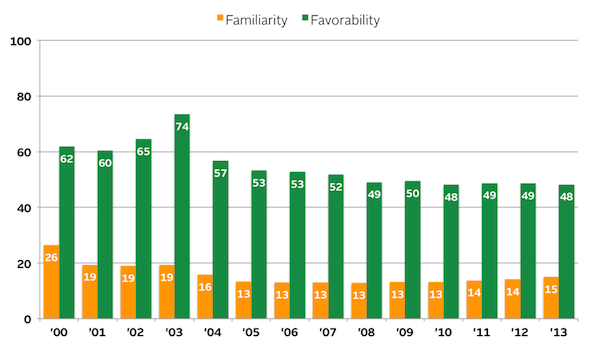
    CRUDE OIL: Familiarity and Favorability 2000-2013

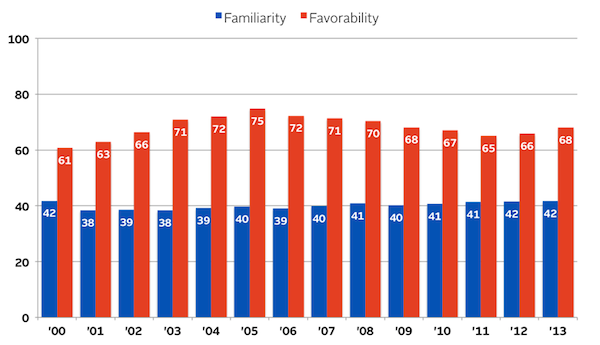
    PETROLEUM REFINING: Familiarity and Favorability 2000-2013

    Analysis:

    This is an illustrative case study of how different links in a supply chain can show startling differences in how they are influenced by given events over time – and how their brands and reputations are impacted.

    Sample companies in Crude Oil: Anadarko Petroleum, Apache Corporation, Baker Hughes, Canada Southern Petroleum, Enterprise Products, Halliburton.

    Sample companies in Petroleum Refining: Ashland, BP, Citgo Petroleum, Exxon Mobil, Hess, Murphy Oil, Occidental Petroleum, Royal Dutch Shell, Tesoro Corporation, Valero Energy.

    Since 2000, both the crude oil sector and the petroleum refining sector have seen wide fluctuations in price and other major news and political events. Consumers have been impacted more directly by price and market gyrations in these sectors as prices they pay at the pump, to heat their homes, and for many of their energy needs are subsequently affected.

    The corporate brands of both sectors – petroleum refining and crude oil – are highly sensitive to market conditions, price fluctuations and accidents, which make reputation management an important component of corporate governance. Understanding the long term trends of each segment of the industry combined with an individual company performance within an industry is fundamental to managing the impact of the brand on corporate enterprise value.

    Corporate communications officers can use this information in their long-term strategic planning as they look to develop communications and government affairs plans. Given the fluidity of consumer opinions in the crude oil and petroleum refining sectors, companies have to be more reactive in the short term to protect and promote their reputations. Failure to respond quickly to events – or significant delays in doing so – comes with a much steeper reputational cost. As a best practice, companies should adopt a long-term strategy to consistently increase their brand valuation year after year.

  • NSA ‘Equation’ Fallout

    New York, NY (February 17, 2015) – Original article at: International Business Times

    Revelations that the National Security Agency implanted spyware into hard drives sold by top American tech manufacturers stand to further damage the international sales of those vendors and further degrade the U.S. government’s diplomatic relations with countries, many already stinging from previous NSA spying programs, abroad.

    “This is yet another instance that has led to building this viewpoint that the U.S. government and U.S. companies cannot be trusted, and whether that is correct or not, it’s harder and harder to combat that idea,” said Jake Laperruque, the Center for Democracy & Technology’s fellow on Privacy, Surveillance and Security. “That’s going to cause problems for U.S. businesses.”

    The spyware, which has been dubbed “Equation,” was discovered by Kaspersky Lab, a Russian security software maker that over the past few years has built a reputation for uncovering American cyberespionage operations. Kaspersky Lab revealed the operation late Monday evening.

    It is strongly believed that the NSA is behind Equation and has been building spyware directly into the firmware of hard drives sold by companies like Western Digital, Seagate Technology, Micron Technology and many others since 2001. That spyware was then used to monitor the computer activities of top foreign targets in countries like Iran, Russia, Pakistan, Afghanistan, China and others, according to Reuters.

    “Short of something major like Congressional action, it’s going to be hard to break that narrative that we can’t be trusted,” said Laperruque. “The trust has been withered away so significantly.”

    Since the revelation of PRISM in 2013, countless cyberespionage operations have been tied to the NSA, damaging the U.S. government’s relationships around the globe. Equation is the latest example of that and the “icing on Snowden’s cake,” said Igor Baikalov, chief scientist at Securonix, a security analytics and intelligence firm.

    “While Kaspersky stopped short of attributing ‘Equation Group’ activities to any specific entity, the list of clues discovered and especially the list of targets leaves little doubt that eventually it will be tied to NSA,” Baikalov said. “The question is: does the U.S. government care anymore?”

    Since whistleblower Edward Snowden came out two years ago with revelations of widespread cyberespionage by the NSA, American businesses have been negatively impacted as countries around the globe lose their trust U.S.-made tech. Qualcomm, IBM, Microsoft and Hewlett-Packard have been among companies who’ve reported diminished sales in China as a result. In Brazil, Boeing missed out on a $4.5 billion jet contract due to the NSA’s activities. The total damage to American tech businesses could amount to as much as $180 billion, according to an estimate by Forrester Research’s James Staten.

    “This will most certainly have a long-term impact on the brands of the companies involved — Seagate, Toshiba, and Western Digital — at the very least tainting their products as suspicious,” said Jim Gregory, chairman of Tenet, a brand innovation and marketing firm. “Their corporate brand will be impacted and the damage will last from three to five years depending on how actively they manage the crisis.”

    As for companies that are concerned with what Equation could mean for their own computer systems, there really isn’t much that can be done other than having an expert go through their computer system code and manually ensure there is no spyware installed. “One cannot simply install any antivirus product off the shelf and expect to be fully protected, even if you have Kaspersky,” said Brett Fernicola, chief information security officer for STEALTHbits Technologies, a provider of data security solutions.

    “Hackers today are writing new viruses and malware that are extremely complex that go months without detection,” said Fernicola. That, apparently, may include the National Security Agency.

  • Brandstorm – The benefits of being responsible

    New York, NY (January 30, 2015) – Original article at: Business Observer

    Corporate Social Responsibility (CSR) is often confused with other terms such as sustainability, good corporate citizenship, ethical business practices, environmental responsibility, philanthropy, charitable giving, etc. Although each of these is a form of CSR, they are collectively a set of tools available to convey a leadership mindset focused on managing a corporation as part of a larger social fabric.

    Even the term itself, “Corporate Social Responsibility” sounds like a nuisance that those who are too busy with running a small business may prefer to avoid if possible. But when CSR is woven into your corporate DNA, you will find it one of the best ways to build your corporate brand and customer loyalty.

    In an excellent article entitled, “The path to best in class CSR: Deloitte” published in the Jan. 10 issue of Business & Leadership, Deloitte managing partner Brendan Jennings captures the essence of the issue. “What I don’t want is for our staff to hear CSR and just think of volunteering or something relating to the environment. Those things are all very important, and our people want to do them, but CSR is a much broader concept than that.”

    For Jennings, Deloitte’s CSR positioning is a key component of its business strategy. “Organizations that are clear in their purpose achieve more. Our purpose is to be a quality provider of services … one that does its best for its clients, its people and the wider community, and one that can stand over everything it does.”

    Jennings goes on to say, “In relation to the clients we serve, it means doing our very best, for a fair fee. When it comes to our people, who are our greatest and, indeed, only asset, if they believe in doing things the right way, good corporate governance is easier to ensure.”

    To identify the kind of CSR projects that bring measurable ROI to your company, you need to give it the same kind of thought that goes into building a marketing plan or a media strategy. You need to be certain that it fits within your larger business strategy. Think about the essence of your company. What does it stand for? What do you believe in? Do some CSR programs resonate better than others? Is there one that clearly fits your business model? If you are lucky enough to find the perfect CSR fit, then you need to develop a plan to create differentiated positioning — after all the key to branding your company is differentiation.

    Consistency, commitment, and communications are also important to getting the most value back for the effort you make in CSR. I worked with The Reader’s Digest Association prior to its initial public offering and reviewed its many and generous CSR activities. One example is, the company provided funding for the massive beautiful vase of flowers at the entrance of the Metropolitan Museum of Art in New York — but it never attached its name to the action. I pointed out that while an anonymous gift is admirable, it is also somewhat selfish. Even a small unobtrusive plaque in my opinion is generating goodwill among key audiences such as employees who would also like to share in the good feeling achieved by your company’s CSR program.

    CSR benefits to remember:

    Employees care about your CSR programs and want to be involved;

    Include CSR activities as part of your recruitment package to help to attract the most desirable candidates;

    Consumers are increasingly aware of sustainable business practices;

    Consistent CSR practices lead to customer loyalty;

    If possible, you should own (brand) your signature CSR activity;

    Know your suppliers and their CSR policies to avoid issues that could reflect poorly on your company;

    Monitor social media to understand how your company’s CSR policies are seen by others; and

    Train your management and employees how to speak about your CSR programs to maximize the goodwill created by these activities.

    Deloitte’s strategy was summed up: “When your people know why they are doing what they do, that helps protect not just the organization but the brand and the client, too. That is what makes CSR so hugely powerful, and about far more than fundraising or volunteering.”’

    Corporate Social Responsibility is a key component of the best long-term business strategies for companies of any size. Corporations must be ever mindful of the impact they have on the world in which we live. Understanding the immediacy of communications today and the impact that they can have on your corporate brand means that CSR needs to be a fundamental part of your communications platform and your corporate DNA.

  • Understanding and Measuring the Value of Marketing in Brands

    New York, NY (January 29, 2015) – Original article at: The Price of Business

    After interviewing James Gregory in December 2014, I was able to follow up with him to better understand the Value of Marketing in Brands.

    John Wanamaker said, “I get half of my business is from my advertising but, just haven’t figured out which half.” Mr. Wanamaker discovered this dilemma when he opened his first store in 1861 in Philadelphia. Considered an early marketing genius, Mr. Wanamaker used advertising to drive traffic to his stores. The statement that he made regarding his dilemma has negatively impacted the world of advertising and marketing over the years. Wanamaker’s statement leaves the impression that half of the money that is spent on advertising goes to waste; this is not an accurate observation.

    Advertising builds awareness and if it is not creating the effects that you want to see immediately, it is still creating an impression about the business that you are advertising. Studies have shown that over 80 percent of advertising yields measurable results.

    As part of the Marketing Accountability Standards Board (MASB), James Gregory is bringing together top academic professionals and senior business leaders from around the world to discuss the significance of value for brands and how it is reported in company financials. While owning a consulting firm for numerous years, he decided to get involved with MASB after witnessing first hand the destructive effects of insufficient advertising budgets in cases where the value of the brand was not fully understood by senior level management. As the residing co-chair of MASB’s Improving Financial Reporting (IFR) committee, he stands by what MASB can do for our industry. James was the first in his industry to open up our company’s brand valuation model known as the “black box” to be the subject of MASB’s audit, something he is very proud of.

    MASB‘s mission is to “establish marketing measurement and accountability standards across industry domain for continuous improvement of financial performance, to encourage the guidance and education of decision makers as well as users of performance and financial information”. Two game changing innovations are The Brand Investment & Valuation (BIV) project and the Improving Financial Reporting (project). MASB, a dynamic organization currently has 7 additional projects underway.

    We need an organization like MASB because it is a purpose-driven non-profit that focuses on understanding and proving how brands create value. Once value has been proven, MASB changes the way it is accounted for within the corporation. Both fiance and marketing are brought to the same table to discuss the issue of how intangible assets can be measured and valued over time. Of course, that which can be measured and valued can surely be managed. This may seem like common sense but, there has been a tremendous gap between marketing and finance for well over 100 years. MASB is bringing the two sides together for an invaluable experience that will benefit every corporation.

    MASB originated from the need of both marketing and finance to work together in order to create a solution for budgeting constraints and marketing dilemmas. Many times, marketing and advertising budgets are drawn from educated guesses of what it would take to do a job versus being treated like additional business assets. Understanding a precise and consistent method of valuing the potential ROI for marketing programs is a critical goal of the effort.

    In figuring out the strengths of a corporate brand, it is necessary to understand that corporate brands represent one aspect of creating brand value. James Gregory’s company was challenged by GE in the early 1990s to develop a model for evaluating how advertising impacted the company’s image while also identifying the value created. As one of the oldest, continuous, quantitative benchmark research projects, the study known as the CoreBrand Index® is used in over 1,000 companies across 50 different industries.

    In activities such as advertising, marketing, public relations, and investor relations, an organization can track how their branding strategies affect the corporate brand in several ways. When there is a continuous quantitative, benchmark tracking system in place, communication activities have a cumulative effect that can be identified. Massive data on many companies allows them to run regression models on what actually drives value. At Tenet Partners, Gregory is always tracking the image of 1,000 companies and communicating results on a quarterly basis.

    After over 25 years of research, he has determined that everything a company says and does will have an impact on the image of a company and how it is perceived. These actions are measurable and will impact both the revenue and stock of the company. It may sound cliché but people like to do business and own stock with companies that they know and trust.

    Because a brand is an intangible, it is not usually on the balance sheet and by the Generally Accepted Accounting Principles (GAAP), it cannot be placed on a balance sheet unless it has been bought or sold. Because of this, intangible assets grown internally are often represented as having no value. In 1975, intangible assets represented 20 percent of total enterprise value. Today, the numbers are different; tangible assets are well over 80 percent of the value of the company. This dynamic presents a problem for marketers who are seeking to grow their assets. In one scenario, marketers are working to grow the value of the brand however, the CFO does not see value being created because the brand is not on the balance sheet. This creates a unique challenge for marketers and it is obstacle to corporate growth.

    If brands are on the balance sheet, there would be a consistent measure for each and every constituency to evaluate where marketing dollars have been invested and if they have been invested wisely. Mr. Wanamaker would be able to approach this impact from both sides of the investment…revenue and enterprise value. For marketers, the argument changes from “if we should advertise” to “here is the potential ROI of our campaign budget”.

    Based on James’ research, approximately 70 percent of marketing budgets are below optimal levels and 20 percent are over optimal levels; this prevents marketing activities from being funded properly. There are actually only about 10 percent of marketers that get a maximum ROI. Marketers must benchmark track their brands in order to have a greater understanding of the value being created. They must also develop ROI models that project the kind of value available through marketing. Through companies like his, these models do exist as well as through competitors or by creating their own model.

    The gap between marketing efforts and financial outcomes goes back to Mr. Wanamaker’s initial dilemma. If your thought process is that you are going to waste half of your budget then, you are going to reduce your overall budget; this is a losing proposition to confront year after year. The “GAAP” became institutionalized, setting the standard for organizations and accounting firms, giving them no incentive to fix what is clearly broken. MASB is the one organization that challenged this issue head-on and continues to work on fixing it in a methodical and intelligent manner

    We can sometimes lose sight of all of the progress that we have made in fostering the dialogue between fiance and those setting the standards of accountability in marketing. With regards to measuring and planning, we have come a long way but, until the standards are indeed changed, we should continue to pursue and persuade whenever possible and the best way that we can. At MASB they appreciate additional input shared by business leaders who are as intrigued as James was by this crucial subject.

    The key to unlocking the value of marketing is to understand that it adds value to both brands and corporations. Although it is a tough argument, it is a worthy cause and for this reason James Gregory joined MASB.

  • Delivering the Customer Experience

    New York, NY (January 09, 2015) – Original article at: Business 2 Community

    The new high ground for the CMO

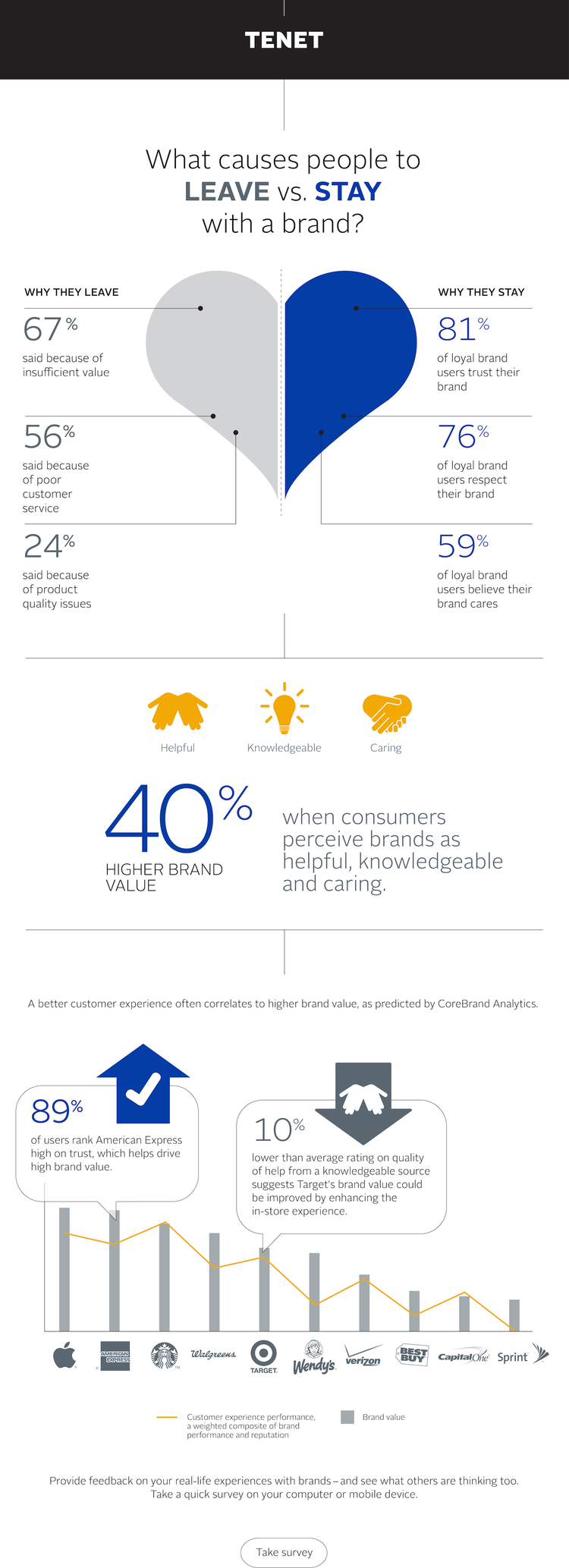
    Tenet Partners research shows that brands with high familiarity and favorability, combined with a rich customer experience, can have a brand value more than 40% higher than their competitors. Consumers are more likely to trust, respect and recommend these brands, creating a virtuous cycle for customers and shareholders. Customer experience, then, is an increasingly important point of differentiation. Yet, many companies still fail to deliver the experiences their customers expect. Why?

    In the 2014 Tenet Partners consumer experience study, 56% of customers cited a poor service experience as the reason that they left a brand. What would you do if half the customers abandoning your brand did so because someone on the front lines delivered a bad experience? I imagine that most CMOs would say that they would do whatever it takes to treat their customers better.

    The problem is that the CMO has not traditionally been responsible for designing, delivering and managing the customer experience. This is changing rapidly thanks to digital platforms that are remaking marketing, communications and the delivery of customer experiences. CMOs at leading brands and forward-thinking companies are being asked to step into new operational areas to help craft and deliver the customer experience. In large part, the digital transformation of business models – and the resulting integration of brands into digital and physical touch points – is enabling and accelerating this shift in role.

    Yet, few executives stepping up to this new business challenge are truly prepared to tackle this domain because marketing has been isolated from operations. Traditional marketing has focused expressly on advertising and communications rather than the overall experience. Fortunately, driving customer experience in a digitally charged world leverages capabilities marketers already possess – specifically, the ability to gather market insights and develop brands that reposition companies toward market opportunity. But today, more skills are needed to successfully address the bigger picture.

    Marketers need to become engaged in – and adept at – developing business strategy, driving innovation and implementing systems that shape the actions of entire organizations. These three dimensions, combined with a strong understanding of the brand, are the tools for driving growth. By engaging with their peers in the design of the business and digital platforms, CMOs help align the business model, culture and operations to the brand. Companies that do this well have a unique opportunity to deliver compelling customer experiences and create enormous competitive advantage.

    American Express is one of the strongest brands, according to the 30 years of historical data contained within the Tenet BrandPower Database; it also scored well in our customer experience study. The story, especially versus Capital One, is very compelling. The research results show higher levels of trust among Amex users, which is an essential element for brand loyalty. At a tactical level, the research also suggests that Amex, to a greater degree than Capital One (and most other brands in the study regardless of industry, for that matter) provides the knowledgeable help its customers expect. In addition, Amex engages with customers in a way that respects their unique needs. This includes orchestrating touch points across all channels, including digital. All of these activities are essential to providing a satisfactory experience.

    A closer look reveals the impact of other innovations that Amex is driving across its platform. From everyday membership benefits to shaping mobile payment systems and driving fresh innovations to new markets, the company is steadily creating deeper levels of customer engagement. This in turn raises barriers to competing firms.

    Bottom line: American Express focuses on the value that it delivers through a highly tailored customer experience that is tightly aligned to its brand attributes. When compared to Capital One, which focuses its primary investment on growing its credit card share through advertising, American Express is winning the battle for the best, most loyal customers.

    The lesson is clear. The tried and true pillars of service, value and quality that are aligned to your brand and business model are still the most important. When CMOs concern themselves with value creation by delivering and managing a rich customer experience, they are not only driving marketing, they are driving competitive advantage and enterprise value.

  • Executives: Be the brand at your firm

    New York, NY (November 28, 2014) – Original article at: Business Observer

    We like to think that great CEOs have steel in their veins, but there are many other qualities associated with great leaders, such as the ability to delegate and inspire confidence. Other essential qualities include trustworthiness, visionary leadership, financial acuity and the ability to communicate clearly. Of all these qualities, the most important is the ability to communicate. That, more than any other, is a CEO tool by which all other qualities are distributed. The distribution system is called “corporate branding,” and a CEO who masters that is a true leader.

    A great CEO has brand foresight. While many great ideas come from below, the most famous and admirable brand strategies start at the top. Leaders of enormous vision and enthusiasm who are willing to take calculated risks and allow their brands to stand for more than utility. A brand is more than a soft drink. A brand is more than a car. A brand is more than a jet engine. It’s what turns those products into a pause that refreshes, the ultimate driving machine, or imagination at work. These are not just empty slogans: They represent the core values that companies and their leaders were willing to stake out and claim.

    Creating a brilliant corporate brand requires leaders with great will and courage. The CEO must have the foresight to actively communicate the brand’s strengths to every key audience, including customers, employees, investors, and the board of directors. Each audience represents one facet of the brand’s overall strength, and the CEO must ensure each is well managed and carefully articulated.

    Resist the status quo
    Without a strong sense of mission and the courage to carry it out, no CEO is equipped to handle the complexities of growth management. Leading a company to brand brilliance requires great imagination and forward thinking and a willingness to jettison an outdated philosophy and complacence from past successes. The true leader is never satisfied with the status quo. Brands constantly move, grow, adapt, and respond — or fade into mediocrity. But that inherent motivation to build a new brand needs to be balanced with an understanding and respect for the heritage where the underlying brand equity resides. That balancing act is what separates the merely good from the great leaders.

    Great leaders make their brands extensions of themselves — they embody the spirit of the company and make customer satisfaction in their products a personal mission. They impart their enthusiasm for and commitment to the brand across the entire enterprise, from the boardroom to the executive suite, from the production floor to the delivery door, from the salesperson to the end user. When they do, their brands can become icons such as Coke, Apple, Virgin, Ben & Jerry’s, Macy’s, Ford, Amazon, Google, Starbucks, and of course, Berkshire Hathaway.

    Accountability starts at the top
    So how does a company move toward a superior corporate brand? Here are moves the CEO can take to lead his firm there.

    The CEO must monitor the corporate brand for strength, weakness, and any opportunity for change that could positively (or negatively) affect corporate health and vitality of the company.

    The board should tie the CEO’s compensation to the growth of the corporate brand because it is a bellwether of the company and it impacts so many aspects of the company’s performance. The CEO should report on the corporate brand to the board each quarter.

    Despite the corporate brand being an intangible asset, the CEO should encourage and embrace the valuation of it to understand the financial importance of this growth generator.

    The CEO should evaluate marketing communications budgets based on the potential ROI and according to the company’s long-term goals and vitality of the corporate brand.

    To continuously guide long-term strategic planning, the CEO must have empirical data and insights into industry, technology, and consumer preferences that affect brand strength and/or brand equity.

    The CEO must hold his senior management team accountable to exhibit the same high level of commitment to the corporate brand.

    Employee engagement must be assured through professional training and motivation.

    Bear the flag
    Like it or not, the CEO is the brand’s chief flag bearer. A short-term attitude will not make for a brand of enduring strength. Brilliant brands require long-term commitment to investment and change.

    Great CEOs know this and invest accordingly. They are ardent champions of constant growth and evolutionary change. They encourage operational improvement and direct corporate restructuring before outside forces such as technological advancement and consumer evolution leave them in the dust.

    They are at the vanguard of industry change, not bringing up the rear — and they invest the capital and time needed to ensure that their brands remain at the forefront.

  • How to Make ALL of Your Advertising Work for Your Business

    New York, NY (November 26, 2014) –

    Host Kevin Price, Co-Host Jason Smith, and Guest Jim Gregory discuss “How to Make ALL of Your Advertising Work for Your Business” on this segment of the Price of Business.

  • Bored Games? Not at All

    New York, NY (November 20, 2014) – Original article at: The Street

    They may not be the most popular toys this holiday season – little boys are asking Santa for LEGO toys, while little girls want Frozen dolls – but board games are still in demand.

    Compared to 2013, Amazon’s (AMZN) board games sales are up 30% year-to-date. Hasbro (HAS) , which produces games including both Monopoly and Scrabble, says revenues are up 2% in the third quarter of 2014 to $395.2 million.

    Even with new and cooler toys being introduced year in and year out, old-fashioned board games are not going away, says Jim Silver, CEO of toy industry site TTPM. Monopoly and Scrabble, which have been around since the 1930s, remain prominently displayed in the games aisles of major toy retailers.

    “These games are so special in that they are able to gather the whole family or a group of friends around one table, exchanging laughs and physically interacting with each other,” says Silver. “The Sony (SNE) PlayStation, Microsoft (MSFT) Xbox and Apple (AAPL) iPad can’t really give children and adults that same experience.”

    Aside from being gender neutral, board games are unique in that they offer the same level of enjoyment to both children and adults.

    “My little girl loves playing with her doll but I could never have as much fun as she’s having. With board games, we can compete and have fun at the same time,” Silver said.

    This year, Monopoly and Scrabble are introducing new features to keep people excited about the games.

    Hasbro has launched the My Monopoly app, which allows players to customize property spaces, game tokens, Chance Cards and Community Chest Cards to include their favorite people, places and things. Using the app (or the My Monopoly site), users can gather photos, print them out on personalized game stickers and stick them onto the game pieces.

    Scrabble, on the other hand, has added a new electronic scoring tool. Instead of keeping a printed scorecard, players just dial-in their scores on a handheld unit. It includes a timer option and a highest-word-score feature that lets players know when the highest scoring word has been reached.

    “They certainly know how to innovate and they’ve been utilizing social media to get their customers involved in making product enhancements,” says James Cerruti, head of research and strategy at Tenet Partners, a brand innovation and marketing consultancy.

    Last year, Hasbro conducted a “Save Your Token” campaign on Facebook (FB) , where fans from 185 countries voted the Cat as the newest Monopoly token, replacing the iron. The new token was included in the Monopoly game released in mid-2013.

    This year, Hasbro crowdsourced new “house rules” for Monopoly, which will be included as optional rules in all Monopoly games starting in 2015. A debate was held on the Monopoly Facebook page from March to April and called on the brand’s more than 11.5 million global Facebook fans to discuss 10 “house rules,” including one that said mom can always get out of jail free.

    Early this year, Hasbro also asked Scrabble fans to pick the newest word geocache through a Facebook vote. This marks the dictionary’s first major update in nearly a decade and the first time the dictionary has ever included a word that was voted on by fans.

    “Game board makers like Hasbro have learned from the experiences of other forms of media like newspapers and books,” says Cerruti. “They realize that if they don’t become active on social media, get on with digital apps and be able to offer varieties of play in other platforms, they will become obsolete.”

    Digital versions of Monopoly and Scrabble are available through many platforms such as mobile, console and online through collaborations with licensees with Ubisoft (UBSFY) and Electronic Arts (EA) , among others.

    The Hasbro Game Channel from Ubisoft is a destination for family game entertainment on consoles. It features Monopoly and other Hasbro games such as Risk and Trivial Pursuit. Mobile games from Electronic Arts include Classic Monopoly and Monopoly Slots. Scrabble for Facebook, iOS and Android is also hugely popular.

    Despite the evolution of Monopoly and Scrabble and their availability on various high-tech platforms and channels, Silver says the old-fashioned board games are here to stay.

    “There’s more to Monopoly and Scrabble than just cardboards and plastic pieces or tokens,” says toy expert Silver. “These games are selling the idea of family time, togetherness and social interaction. Parents are more than willing to pay a small price to keep these values alive.”

  • Poor Customer Experiences Destroy Brand Value and Trust

    New York, NY (November 20, 2014) – Complete a five-minute survey on your computer or mobile device. Get started here. A real-time look at consumers’ perceptions of each brand will be available after you complete the survey.

    Unhelpful, uninformed and uncaring customer service can cause lasting damage to a brand, according to a new study from Tenet Partners. Among consumers who said they stopped using a brand more than six months ago due to problems, two out of three (67 percent) did so because they no longer felt they were getting sufficient value for their money. More than half of these consumers (56 percent) blamed customer service for their defection. One in four of them (24 percent) cited product quality as the reason they left.

    “Customer experience significantly influences brand strength and brand value,” said Hampton Bridwell, CEO of Tenet Partners, the new brand innovation and marketing firm created from the merger of Brandlogic and CoreBrand. “It takes years and significant financial investment to build a strong consumer brand, but all that time, money and effort is wasted every time a customer has a bad interaction. Over time, those are costs companies cannot afford.”

    Tenet’s study links newly-fielded consumer research with CoreBrand’s heritage of corporate brand data to understand the impact of the customer experience on brand value. The findings demonstrate the powerful financial implications of poor customer experiences on corporate brands, particularly in the consumer products, financial services, technology, food and beverage, and retail industries.

    Across these industries, the study found that brands can have more than a 40 percent higher brand value when customers perceive them as helpful, knowledgeable and caring. Consumers are also more likely to trust, respect and recommend these brands, creating a virtuous cycle for customers and shareholders. The study strongly shows that tried and true pillars of service, value and quality are still most important to building brand value.

    “For two decades, CoreBrand’s data has been providing an accurate measure of brand value and performance. For this reason, CoreBrand Analytics remains a vital practice within Tenet,” explained Tenet Partners Chairman Jim Gregory. “This study is breaking new ground by using this same data to help inform how to implement better customer experiences to protect and grow corporate brand value.”

    When Innovation Pays Off

    In addition to exploring what causes the most harm to brands, the Tenet Partners study also examined the role of innovation in building them up.

    “Innovation is a term leaders must challenge their organizations to think of in broader terms. Companies and shareholders get the greatest return from innovation that is brand-led and enhances the overall customer experience. This embodies the sum of business processes, service culture and communication touchpoints of an organization,” added Tenet Partners CEO Bridwell.

    “Apple, American Express and Starbucks stand out as brands that get it right,” he said. “They don’t innovate solely for the sake of innovation or introduce new products or services in knee-jerk reaction to their competitors. Instead, they have an incredibly deep understanding of who they are as companies, who their customers are, and what they want today and in the future. These best-in-class companies pursue focused innovations that are in service of their customer experience.”

    Participate in the study

    To further its understanding of the connection between customer experience and brand value, Tenet is asking consumers to provide feedback on their real-life experiences with different brands. Complete a five-minute survey on your computer or mobile device by going to https://tenetpartners.com/cxsurvey. A real-time look at consumers’ perceptions of each brand will be available immediately following at https://tenetpartners.com/cxsurvey-dashboard2014. Take the survey and review the data as many times as you have an experience with the included brands.

    Methodology

    The Tenet Partners study surveyed more than 1,000 consumers, comparing the stated performance of select household brands in the consumer products, financial services, technology, food and beverage and retail industries to identify the drivers of customer experience. These measures were then correlated to BrandPower, an aggregate measure of Familiarity and Favorability used by the CoreBrand Analytics team as an indicator of monetary brand value and performance for more than 1,000 companies across 50 industries.

    The CoreBrand Analytics practice of Tenet Partners focuses on marketing decision support and investment return optimization. With the only continuous survey of nearly 25 years, CoreBrand continues to examine the corporate reputations and brand value of major public companies by annually surveying more than 10,000 opinion elites from the top 20 percent of U.S. businesses.

    About Tenet Partners℠

    Formed from the merger of Brandlogic and CoreBrand, Tenet Partners is a brand innovation and marketing consultancy that helps companies create brand value and unearth business opportunities by putting customers at the center of their business strategies.