Author: Tenet

  • When the business evolves, so must the brand

    When the business evolves, so must the brand

    Amgen is the biggest biotechnology company in the world, with a global reach and 20,000 employees. However, the biotechnology pioneer’s origins were more modest. It began in 1980 as Applied Molecular Genetics, with all the characteristics of a Californian, tech-style start-up: millions in venture capital, remarkable talent and boundless ambition.

    Success brought with it the challenges that many fast growing companies expanding into global markets face. The corporate brand was becoming less and less relevant to an increasingly diverse set of audiences. In addition, the brand itself was becoming unwieldy and difficult to manage.

    A brand strategy to match aspirations

    A start-up moving to the big leagues, Amgen needed to convey a sense of stature to establish trust. The old brand personality – formal, bold and communicative of leadership – served the company well at the time.

    However, as the company began to push into the global markets, it recognized that the time was right to recast its image. Amgen reached out to Tenet Partners to help them redirect the brand. Our team of designers charted the course for a new direction, one that shifted Amgen’s position toward innovation and commitment to the discovery of breakthrough therapies that can change people’s lives. The revitalized visual personality expresses the essence of Amgen: its human mission, optimistic spirit and rigorous scientific discipline.

    Putting technology at the service of the brand

    While the company grew, so did the need to optimize its brand management process. With the company expanding globally, simple tasks, such as approving a logo to be used in a sponsorship or getting the legal language right on a piece of collateral, were eating up valuable time and resources. Given the importance of Amgen’s mission, it was vital to have a process that would be efficient, freeing people to turn to other pressing matters.

    Brand Ensemble™, Tenet’s brand asset management technology, allows the team to streamline many of those tasks by using a single, worldwide repository of information, standards, resources and workflows. By moving away from manual management practices, the Amgen brand team has been able to improve consistency and efficiency on a global scale.

    For Amgen, one of the biggest benefits that comes with Brand Ensemble is automated advertising. This tool allows communications specialists, anywhere in the world, to quickly produce a corporate ad. This process saves weeks of back and forth, legal time and lets Amgen be in the market faster.

    Positioning for continued success

    The challenges that Amgen faced as it grew into a global biotech powerhouse show how brands – and the way they’re managed – need to mature over time. Building an enduring, viable brand takes the kind of smart leadership and forward vision that has marked Amgen since the beginning.

  • CenterLight – Taking care of the caregivers

    CenterLight – Taking care of the caregivers

    There’s a history of caring at CenterLight Health Systems that reaches back to 1920. Originally known as Beth Abraham, this institution has been an integral part of the diverse neighborhoods and ethnic communities in the New York metropolitan area.

    With an unwavering commitment to providing quality managed care for the elderly, ill and disabled, the CenterLight parent company was operating in a challenging business environment, due to on-going regulatory changes in both the New York and federal health care policies. To stay ahead in this disruptive market, CenterLight has to continuously adapt and innovate. The leadership team and board saw that a single, unified brand for their individual long-term care companies, residential facilities and day centers would optimize resources, making the organization more competitive in the markets it serves.

    The organization turned to Tenet Partners to help bring the new brand to life by enhancing, managing and implementing an institution-wide branding program. Over the course of six months, the Tenet team worked onsite to help CenterLight manage implementation of the program. This partnership resulted in a 20% increase in productivity for the CenterLight marketing team, an impressive number for a non-profit organization charged with doing more with less. Tenet also orchestrated a massive and exciting 24-hour Day One launch with simultaneous activities in facilities, a “countdown to launch” microsite that acted as a virtual brand gathering place, printed materials and live media events to introduce the brand to every employee and participants.

    Shaping the CenterLight Culture for employees

    Using the tools of service design, the Tenet team mapped the entire employee journey to find insights and innovations that would help instill the brand values from recruiting through onboarding and beyond. Tenet helped the Human Resources department rethink orientation by focusing on the importance of the CenterLight values and its culture of caring.

    With over 4,500 employees who speak more than 75 languages, CenterLight also needed to share its values in a way that recognized the cultural and linguistic diversity of its workforce, those who care directly for members as well as those who interact only with their fellow employees.

    Training to live the brand

    Working with CenterLight’s senior leaders, Tenet developed realistic case studies to use as training tools in workshops with functional employee groups. Their personal experiences defined actionable behaviors that could bring the values of the brand to life. Tenet then used the employees’ definitions to inform headlines for a series of internal posters that champion the values in human ways using graphic humanistic illustrations that cut across all diversities. To insure that the values and behaviors would be communicated to all employees, Tenet next hosted train-the-trainer workshops and created a manager’s playbook that will help CenterLight keep their values relevant and present.

  • Citrix Systems

    Citrix Systems

    2008 marked an important year in the growth of Citrix Systems. Having just broken the $1 billion revenue mark and completed numerous successful acquisitions, Citrix had earned its seat at the “big table” as a contender for leadership in desktop virtualization and cloud infrastructure solutions. Global companies, like Microsoft, were knocking at the door and looking for partnership opportunities. It quickly became obvious that something had to be done to give the brand the stature it deserved and to create the brand experience clients were looking for.

    Now a strategic partner with Microsoft and a key competitor to big-league players like Cisco and Oracle, Citrix had to shed the ad-hoc branding practices of its days as a scrappy tech startup. Citrix reached out to Tenet Partners for help. Starting with a re-tuning of the brand positioning from functional-based (access) to a broader, benefit-driven strategy (infrastructure), Tenet’s team of strategists and designers worked together to translate the new direction into a brand identity that expressed openness, transparency and scale.

    Now that it was playing in a decidedly different league and appealing to a much broader market, meaningful connections with their customers were going to be key for success for Citrix. To that end, it was vital to create a more robust and clearly defined partnership and ingredient branding program. Tenet helped rationalize, structure and communicate the expanded program. The program was recently voted one of the best channel programs in the market.

    Citrix continues its growth trajectory, doubling their revenue to just under $3 billion in six years. When customer experience and business strategy align, the sky’s the limit.

  • Vantrix – Opening express lanes to quality mobile video experience

    Vantrix – Opening express lanes to quality mobile video experience

    Looking beyond the challenge to the opportunity that laid ahead, Vantrix, a company born out of the alliance of two leading Canadian industry innovators in optimization technologies, saw how the customer experience in the mobile video arena was falling short of its full potential. Technology hurdles stood in the way of optimized content – mobile TV, video on demand, multimedia alerts and messaging, user-generated content and video share – being delivered in a seamless fashion to audiences everywhere and on every mobile devices.

    Vantrix’s vision: change the paradigm by developing software that would enable content owners and service operators to optimize their media processing operations and give their customers the highest-quality media experiences on any device, at the lowest possible cost. Major corporations including ABC News, Orange, T-Mobile and The Weather Channel were ready for a solution.

    The beginning of a new era in telecom

    Vantrix was looking for a powerful way to signal its arrival and express the transformative nature of what the company was bringing the marketplace. Working with the executive leadership team and the organization’s investors, Tenet Partners repositioned Vantrix around its industry-leading technology and its ability to take something complex and reshape it into something simple. And this is where the Vantrix brand idea took root, in a simple yet almost revolutionary phrase: “We make mobile video work.”

    A vision for everyone to see

    Next, our design strategists explored a number of conceptual directions to support Vantrix’s future-focused strategy. The team quickly narrowed in on the human eye as a metaphor for what Vantrix delivered. The logo represents the impressive structure and function of the human eye. It alludes to both the end-user experience and the integrated, seamless way Vantrix works with its customers.

    Launched at the CTIA Wireless Conference in San Francisco, the new brand helped Vantrix capture imaginations and mindshare. It set the stage for them to define how multimedia content should be processed and exchanged over wireless networks. Today, Vantrix’s technology is part of everyday life for millions of mobile content consumers, worldwide, a testament to its ability to continue to “shape how the world experiences media”.

  • Greater clarity for Epiq

    Greater clarity for Epiq

    A pioneer and leader in the legal services and technology solutions space, Epiq recognized that their growing and complex array of business offerings was creating a challenge. After years of strong opportunistic growth, the company found itself presenting a fragmented, product-based image to the marketplace. In effect, the company’s successful expansion strategy had diluted the impact of its brand.

    Epiq began taking strategic steps to reposition the company and Tenet Partners was called on to help. The goal: to transition the brand from a technology-based document review company to a value-added service partner known for handling a wide range of highly complex legal challenges for corporations, law firms, financial institutions and government agencies.

    A new focus on what makes Epiq unique

    We began by refining Epiq’s purpose statement and core values to embody the principles and aspirations of the organization. The values were constructed to be meaningful and actionable across the company.

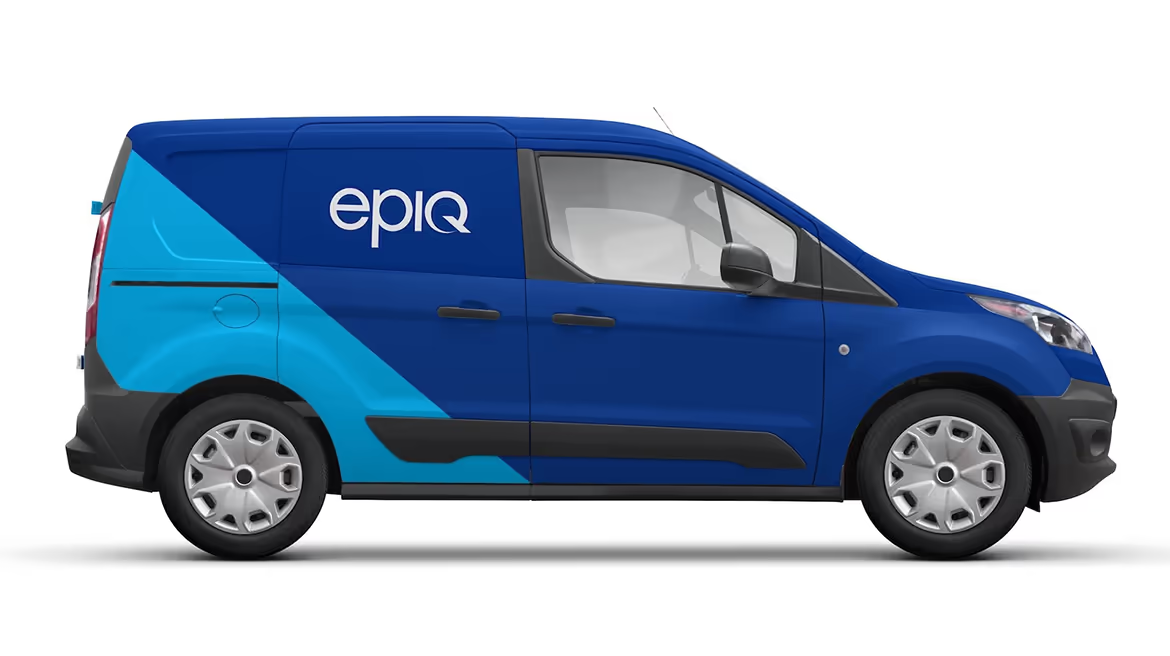
    Recasting the company’s purpose and values was key to powering internal change. Complementing that shift and telegraphing it to the marketplace called for a new visual identity, inspired by the differentiating nature of Epiq’s global scale, high-quality staff and service. Tenet contemporized the Epiq logo and developed new design elements, including a color palette, imagery style, typography and distinctive graphic elements, which brought together the company’s many and diverse business lines in a fresh, unique visual expression.

    Reconstructing the website to meet the needs of many

    Moving the Epiq brand away from its product-based image met a key competitive need. When law firms, corporations, financial institutions and government agencies search for a partner, they are looking for the one who can ease their burden, a partner who understands what they need, has the right expertise and can deliver the outcomes fast. Accordingly, Epiq’s online presence needed to communicate more powerfully.

    A central goal of Epiq’s new website was to allow users in different market segments to easily discover information and navigate the company’s complex offerings in a highly efficient and compelling way. To do this, Tenet conducted an interactive work session with managers across all business lines and functions to discover what the site should deliver to visitors. The task was challenging due to audience diversity: law firms and corporations using eDiscovery and document review services, law firms using bankruptcy case management software, and administrative services and trustees managing large-scale class action claims administration.

    With this insight in hand, Tenet created an information architecture based on solutions organized to align with user’s needs in different market segments. A library of visual icons was created to help differentiate product and service offerings, helping users to find information at a glance.

    Investment in the brand that drives results Epiq’s new positioning, coupled with the visual identity system and website, elevated the brand’s stature and enabled its designers and communicators around the globe to present a cohesive brand expression whether in the U.S., Europe or Asia.

    More importantly, the changes provided a strong platform that helped make Epiq an attractive acquisition opportunity for private equity firms. In 2016 Harvest Partners and OMERS took action resulting in the combination of Epiq with DTI Global to create the first billion-dollar global legal process outsourcing company just eleven months after the brand refresh was launched.

  • MICROLIFE / CHILDREN’S DIGITAL THERMOMETER

    MICROLIFE / CHILDREN’S DIGITAL THERMOMETER

    Challenge

    In a highly competitive children’s thermometer category, with new and diverse technologies continually expanding the field of play, Microlife sought to better understand the needs and concerns of parents, identify high priority attributes, and create kid friendly product solutions ideal for family use.

    Methodology

    Working collaboratively with target parents and client stakeholders, our innovation team utilized consumer sessions to empathically surface emotional and functional concerns and wishes. Roleplaying and forced association exercises, among others, inspired the creation of desired attributes and features visualized with live sketching for immediate directional validation and iterative refinement.

    Insights

    “When they’re sick my kids are cranky and they don’t want to cooperate.”

    “Thermometers look serious and can be intimidating.”

    “I worry that germs will spread (when shared) and then everyone gets sick!”

    “Thermometers are hard to clean…but they need to be sanitary.”

    Impact

    Licensed by American Red Cross this unique category entry with detachable, washable tips successfully delivered on mitigating the widely held concern about cross-contamination and recontamination through transferring germs from “sick child to well child”. A distinctive and unintimidating soft and friendly design aesthetic was applied to alleviate the stress and tension often experienced between parent and child at temperature taking time.

  • The new principles for growth as seen through operations

    Today marks the official launch of Tenet Partners, a brand innovation and marketing consultancy, which represents the combined entity of two established firms that joined forces earlier this year — Brandlogic and CoreBrand.

    Yes, we are now presenting ourselves as one with a new name, logo, go-to-market strategy, brand voice and look and feel. We are expressing ourselves via a new personality through a verbal and visual expression that externally brings credibility and energy to our customer-centered growth strategies. But before any of this could even begin to take place, we had to take the time to evaluate the key internal components of the two separate entities that comprise what is oftentimes referred to as “the back room” or back operations of the firm and determine how to launch a successful integration process.

    Any acquisition or merger regardless of how big or small requires that the daily operations continue to run seamlessly while, at the same time, a core team evaluates all operations closely to determine the best practices that will provide clients with an experience they not only expect, but deserve.

    We know that how we are viewed externally is contingent upon how we operate internally. From our phone system to our email address and signature, from scoping, estimating and managing projects to billing and invoicing individually and collectively reflect upon what it is like to work with us every day. With four primary office locations from east to west that needed to be synchronized, we took a close look at a range of touchpoints that impact customer experience:

    • Finance, including financial software, budgeting, forecasting, financial reporting, billing, and AP/AR to ensure compliance, accuracy, responsiveness and flexibility. We have successfully simplified the process for both our team and our clients.
    • HR resources and competitive employee benefits/policies to ensure we retain and attract the best talent
    • Facilities and technology such as office locations, phone, IT and CRM integration to enable constant connectivity among and between locations to successfully service clients around the globe
    • Project management, tracking and scheduling to keep our team and our clients on track, on budget and on time
    • Talent and areas of expertise to instill confidence that we can deliver against our value props and customer-centered positioning. This included assessing our talent across disciplines and identifying growth opportunities.
    • Shaking up our corporate structure, transitioning from a “flat” structure to one that incorporates various levels of talent and career growth, providing our clients with expertise from vast backgrounds and branding experiences. Our new org chart fosters an interdisciplinary environment that supports a range of possibilities to help uncover unique opportunities for clients.
    • Go-to-market strategy–ensuring that our own marketing and digital content and how it applies to messaging through our pitches, website, social media, blogs, books and white papers, public relations and speaking engagements instill confidence in our staff, clients and prospects that our knowledge, experience, know-how and innovative approach will result in solutions that will help make our clients think differently about their businesses.

    All of this needed to be accomplished within a set time frame, while taking into consideration how to best blend two cultures. Our emphasis is on our first applying our customer-centered business strategy with our own customers–our team members. Achieving a successful balance between what we need to do in order to be effective day in and day out by putting our team at the center of our thought processes helped to ground us in many of our decisions. The key was communicating often, and there is no such thing as communicating too often when it comes to staff. While for many of us the acquisition brought feelings of excitement, optimism, renewed energy, career growth opportunities and endless possibilities, for others there were feelings of anxiety, fear and apprehension. Recognizing and balancing the two sets of emotions was critical to our achieving success in launching our new brand.

    Being new to M+As, no one could have prepared me for how integral and challenging this process would be. It is after experiencing a company integration firsthand, that I have now come to understand and appreciate the core attributes for M+A success – optimism, patience, understanding, time (allow for double the amount of time you think will be required), realistic expectations, a dedicated and committed team with a “can do” attitude and making sure that you put one of your key principles for growth at the center of all you do – your employees. While the daily operations and processes that have been identified will help our firm run smoothly, we know that our team is a unique point-of-difference and makes Tenet Partners stand out from all others.

    To say that we have all of this 100 percent figured out would not be 100 percent true; it is still evolving every day. What I do know is that we are confident that we’ve built a strong brand and marketing consultancy that is running smoothly and is comprised of a team of experts who work really well together and are ready to help our clients uncover and develop customer-centered growth strategies.

  • Brand-led Innovation

    Digital is having a profound impact on business strategy, branding and customer experience. It’s clear that organizations need to take a fresh look at how to embrace the shift. But how to innovate successfully in this highly connected environment requires more focus than ever before.

    Over the past two years, I have been steeped in a broad-based management program at Harvard Business School that focuses on innovation and entrepreneurship. The experience has left a permanent imprint on my thinking about how to drive success in a rapidly changing business landscape. The primary theme is focused on making choices. The argument, achieving strategic and executional clarity requires many tradeoffs. In the works of Michael Porter and Earl Sasser, the takeaway can be summarized in one thought. ‘Business strategy’ is about choosing what you won’t do and ‘service excellence’ is about choosing what you won’t do well. It took me a bit of time to grapple with that one, but once I wrapped my head around the idea, it’s a powerful way of thinking. And, let’s face it, making choices is the toughest part of business.

    So, how do leaders build better business strategies and deliver powerful customer experiences? I believe the answer is brand-led innovation.

    For our firm, brand embodies key elements of business strategy, especially the articulation of competitive advantage. Every business has a strategy, whether planned or unplanned, that which at its core is a set of attributes and activities that you have decided to pursue to create distinctive value in the market. If you understand what those activities are, you have made the first step to understanding how to achieve differentiation with your brand. If you understand why customers choose you and how they think of you, you have made the second step to building and managing brand perceptions around your competitive advantage. Unfortunately, and all too often, companies are unclear about their business strategy, their brand, and how to deliver a great customer experience to the right customer. Usually, no one has stopped to look at the big picture and to do the hard job of making choices.

    A central theme of innovation is how to incrementally improve or create new products or services, business processes or new employee behaviors. Increasingly, innovations come through new ways of connecting and communicating with customers using digital and related technologies. For example, something as simple as a mobile app for travelers is using a suite of digital and technology elements to redefine the customer experience. This can have a big impact on the bottom line or fall flat due to a lack of alignment to your strategy and brand.

    If the innovation does not create value for the customer, it will surely be a miss. Again, more often than not, companies pursue innovations for the sake of chasing a fad, and as a result are having a hard time finding the return on those investments. The outcomes don’t produce as much value as possible because the innovations are not intrinsically or extrinsically aligned.

    Enter brand-led innovation. Leaders can create strategic clarity and enhance value by creating alignment with a comprehensive branding program. Brands help people see what a company stands for, their unique capabilities and how they deliver value to customers. Most importantly, an organization gains a better understanding of what customers want, need and value through the branding process. Developing and managing a brand requires companies to look at their business strategy, study their competition and dive deep into the needs of customers. That journey ultimately involves making choices that inform strategy, defines the brand, identifies opportunities for real innovations, and drives value creation. Powerful stuff.

    Organizations that are crystal clear about their strategy, their brand and their customer have the basis to ignite growth.

  • Put experience at the center of your brand

    Brand is a set of experiences delivered, not just promises communicated. When you embark on a strategic rethink of your company’s brand it is critical to keep this in mind from the outset. It isn’t just about capturing the language of repositioning; it’s about engaging your organization to deliver a set of intended, distinctive experiences across customer touch points. This has never been more true than it is in today’s environment.

    Technology is opening up new opportunities to both differentiate customer experiences and establish new or additional incentives for trial, selection and loyalty across nearly every industry. It is accepted that these changes should become factors of business strategy, but they must also be reflected in the definition of brand strategy, experience design and even corporate purpose.

    Mastering the interplay of customer experience and brand strategy is becoming a crucial test for marketers. With brands built more and more through orchestrated experiences, an omni-channel review of customer experience as part of discovery is vital. Without it, no brand team can provide guidance that unifies the direction for brand communications and service delivery in ways that heighten relevance, attraction and the loyalty of customers.

    Integration is the key. Only when you rise above historic patterns to integrate disciplines and processes can you create new value through a customer-experience-centered brand. In today’s digital world, isn’t it time to stop thinking about brand strategy, customer experience, and corporate purpose as related but separate disciplines?

    Let me know what you think.

  • Photography matters when it comes to building a brand

    Recently I drove by a billboard advertising a pharmaceutical and swore I recognized the woman in the ad. I can’t remember the name of the advertised drug, but I certainly remember the handsome, gray-haired woman. I couldn’t instantly place her, but I knew I’d seen her before. And then it finally dawned on me. I recognized her from many hours of searching for royalty-free stock images. I’d seen her in all sorts of situations—from boardroom meetings to intense one-on-one conversations with coworkers. And now here she was walking on the beach!

    A great deal of time, effort and money is spent on building powerful, unique brands. From research and strategy to logos and websites, companies clearly understand the value in creating memorable experiences for customers. So, it makes me wonder why bland, generic stock images are becoming the norm.

    As I continued to think about photography and its role in brand building, I started exploring companies that are clearly investing in creative photography and companies that are clearly NOT. I think we can learn a lot from looking at two very different brands that are certainly getting it right when it comes to their photography style.

    The first is charity: water, a non-profit organization dedicated to bringing clean, safe drinking water to people in developing countries. With a truly distinctive tone, the photography charity: water uses to tell its story is authentic, captivating and always emotional. With far too many non-profits relying on user generated photos that tend to lack consistency and quality, charity: water stands out in a bold and memorable way.

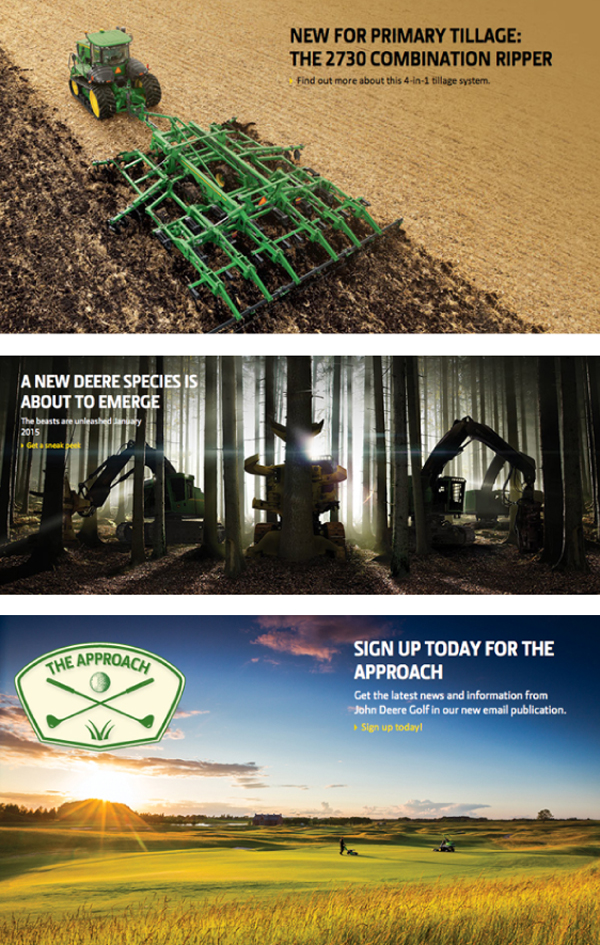
    The second is John Deere, an iconic brand with a long history of using photography that perfectly captures its personality. The quality of the light, the expansiveness of the landscapes and the scale of the machinery is instantly recognizable. The John Deere style is just what it should be: Strong, filled with pride and thoroughly American.

    All brands should be impactful, memorable and distinctive. The right photography can certainly help get you there.